When we enter the Holiday Season, I like to encourage my patients to “make the Holidays whatever they need it to be”. Do you need to grieve? Grieve. Do you need to keep it low key because you are overwhelmed? Okay. Are you in a celebratory mood and you would love nothing more than to decorate? Okay. The holidays should be whatever you need to make them based off of your mental health, financial situation, and psychosocial circumstances. There’s a much higher need to filter out societal, family and romantic pressure’s. Whether you cannot afford presents or decor, or you do not have an intimate partner to enjoy the time with, or you do not have the time or income to visit everyone. Somewhere along the lines, most of us will ‘fall short’. I hope we can enjoy it regardless. Even in micro doses.
To travel or Not to travel? There’s pros and cons to this. If you have the energy and finances to travel, and you want to visit friends or family that are not local, that is understandable. Go for it! If you cannot travel, that is okay too. I personally dislike traveling over the Holidays. I dislike the traffic, I dislike how everything is more expensive because companies know that they can get away with it. Planning something to do at home or somewhere local can be fun. We don’t really have to ‘hunt down the Holidays’, they are brought to us. There is no mandate on where you go or how you choose to spend your time. You can bring the Holiday to your home as well.
Presents and/ or quality time: Think love languages, how we show love is what is most important. Sometimes it’s through gifts, or quality time, or acts of service. We can get creative with our gifts, it does not have to be expensive. It does not have to be a new item persay. It can be family game time, arts or crafts that you made from scratch. It can be through some home made cooking. It can involve walking or driving around and looking at christmas lights. Gifts are often seen as items. But on the contrary, gifts can be visual, a gift can be the fact that we are spending time with people we love. A gift can be feeding our time with activities that calm our souls.
Single during the Holidays: The Holidays tend to cater a bit more to people that are married with kid’s. There are many wonderful family rituals. Embrace your spouse’s & kid’s! If you are single and/ or going through a divorce; the story will be different for you. Grieving relationships during the holiday is brutal. This happened to me last year when I dealt with a break up just 11 days before Xmas of 2023. I couldn’t even be around a christmas celebration last year. What helped was my support system. I isolated but I contacted & facetimed many of my friends and family members; they can truly be helpful when you are going through grief. Of course, make sure you are connecting with the right people. People that are actually supportive vs hyper critical.
Food and Drink: Have you ever tried to go on a ‘diet’ during the Holidays? It’s next to impossible. Between October 31st to New Years day is a rough time for people that are hoping to manage their weight. Or, for people that are trying to cut back on alcohol. On one hand, give yourself some grace because there are far too many appetite and emotional triggers during the Holidays. On the other hand, still care about your health despite the extra temptation. You can have the proper nutrients still, even if you spent the morning binging on leftover Holiday goodies. You can still workout, on the days before and after the Holiday. Or even on the Holiday! I love working out on Holidays because I have the time off! Hence, more energy/ time to actually get a workout in.
Boundaries; they don’t vanish just because it’s a Holiday: One of the fastest ways to destroy Holiday cheer is to pressure and guilt trip friends or family members into spending time with you and/ or getting you gifts. Everyone is scrambling for a plan so that they don’t have to feel lonely. Sometimes ugly personality traits or defense mechanisms come out to play. Let’s remember that respect is very important. Respect that not everyone is in the same place; mentally, financially and in proximity. Respect that everyone has the right to self determination and freedom of will, yes even people related to us by blood. If I get upset around the Holidays for something small such as someone being too busy for me, or unable to get me a present, I know that I need to look inward and check my ego.
A Reasonable New years resolution: The SMART goal is destribed as simplistic, measurable, attainable, realistic and timely. It’s boring, yes. It isn’t as exciting as those crash workout plans or crash diets. But, it’s better because of the longetivity that is associated with sustainable goals that we can actually fit into our schedule. For the people that never meet their New years resolutions, the issue is one of two things. 1- They do not actually want to do that goal. 2- The goal will not realistically fit into their lifestyle. If someone wishes and expects themselves to perform miracles, but then they remind themselves once again that they simply human, they set themselves up for shame sabotage. You can absolutely set a goal/ resolution that you can meet! Make sure that it aligns with your wants, needs, values, and schedule.
This years Veterans day blog is very simple. I asked Veterans to offer advice to military members that are close to getting out of the military and/ or brand new veterans that recently got out of the military. We need to stay proactive in building our veteran community and it starts with becoming the mentors we never had.
“Do not bottle stuff in. Definitely do not drink alcohol. Don’t give your entire heart to someone. Talk about things.” Brock Melvin/ USMC Vet
“Transitioning from active military to civilian life can be extremely challenging, no matter if you served four years or twenty. Connecting with veterans that have made that transition successfully is extremely important. Going through a mentorship program can be very helpful in deciding on and achieving your next chapter. Lastly, be your own champion, look into resources, connect. Ask for help and support when you need it. Veterans will always support one another.” -Khana Sudranski/ USAF Vet
“To all the new veterans stepping into civilian life: first, take a moment to acknowledge the incredible journey you’ve been on. The skills, discipline, and resilience you developed during your service are powerful assets that will serve you well in this next chapter. Transitioning can feel overwhelming, but remember that it’s okay to seek support from fellow veterans, mentors, or organizations dedicated to helping you adjust. Take the time to explore your passions, pursue new skills, and build a support network. The civilian world may seem different, but you’ve already proven your ability to adapt. Stay patient, keep an open mind, and trust that this is just the beginning of a new adventure, one where your unique experiences will continue to shape your success.” -Naveen Kumar/ Navy Vet
“Best advice is have some kind of plan or strategy on the way out. Don’t just assume you’ll find a job or live off the GI bill. Start planning your exit way before you leave. Also consider the reserves because that is potential employment if you need it.” -Lorenzo Soto/ USAF Vet
“Take all of your medical records for screening prior to getting out to see if you qualify for healthcare and other types of benefits.” Ed Escalante/ USMC Vet
“Use your terminal leave to take some time off, but have a set time for that break to end. Use that time to recharge and reflect on both your military career and your future endeavors. Live it up a little and enjoy life. Then be ready for a different kind of grind back in the civilian world. It’s hard but don’t be discouraged, you have a lot of skills and qualities your civilian counterparts don’t. Show up, show out and continue to improve your life!” – Ray Lea/ USAF Vet
“If I could do it all over, I would have not gotten married while I was in service until I was more senior enlisted and simply more mature in life. Not being able to fully dedicate myself to the job in mind, spirit, and body became a challenge in the early years effecting not only my marriage but also my ability to perform at my full potential. Choose wisely who you give yourself to physically, emotionally, and legally. You are worth the wait!” -Dr. Johnny M. Medina, DSW/ USMC
“Make sure you connect with other veterans who have also gotten out so that you can find camaraderie amongst each other. And you can also help each other navigate and learn about veteran benefits.” – Bre Gaudit/ Army Vet
“First, decide your immediate goals; jump into employment, or start using educational benefits? Be sure to network regardless. It can feel awkward, but having connections is your best bet in getting hired after the military and/ or college. Remember that your benefits cover many trade and technical schools as well now; which can be quite lucrative and are worthy of serious consideration.” – Elizabeth Forest/ USAF Vet
“Make sure you always go to medical treatment when you need it, and ignore the toxic work culture.” -Ben Larkin/ Navy Vet
“We need to stand on positivity and constructive habits. This includes working out, training, martial arts, community, service, and mentoring of our current active duty members. Also a strong sense of faith in a higher power. Steering clear of drugs and alcohol is paramount. Often these are used as a crutch. Fighting our demons isn’t easy, but fighting an addiction makes it even harder. Lastly, do not be afraid to reach out to those of us that have been through this, it’s not a weakness, it’s an alliance!” – Mark Geletko / USMC Vet
“First of all, welcome home. There are going to be hurdles throughout your transition. A Vet center will help you navigate through some of those hurdles. Vet centers are clinics that serve veterans that suffer from combat related PTSD and/ or Military sexual trauma (MST). They offer readjustment counseling services and connections to resources and community partners in your local area. They (Vet centers) welcome veterans with warm arms and empathy.”- Victor Dendariarena/ Army Vet
“Don’t Kill Yourself.” – Joshua Dean/ USAF Vet
“To the new veterans, some words of advice. When you first get out, it’s not gonna be easy to transition. This is the real world, and they don’t know anything about the military. You’re going to have to be patient with people because civilians aren’t trained like us. Don’t come out here demanding respect because the civilians don’t understand it. Don’t go back to your old ways, know your worth . Use your military skills to move forward in life. And if it gets too hard or you need someone to talk to, don’t be afraid to ask. Go to your local VA and start your paperwork. You earned it.” -Orlando Ramos/ USMC Vet
“Don’t get distracted, take advantage of every opportunity the military has to offer. Keep your records straight, document everything. Don’t tie yourself down right away, the BAH ain’t that good. Don’t let the long days and deployments discourage you, you are making life long friendships, talk about the things that need to be talked about and try to make a difference while you are in. We are one team, so we are one fight. For the ones getting out, get those medical records straight and file for disability right away when you get out. Don’t let a single day pass where you don’t work toward your benefits, resources or compensation!” -Rachel Braden/ Navy Vet
“Do not do it alone. Reach out and find other veterans who have been out and successfully navigated transition. Don’t be too proud to ask for help.” Michael Parker/ USMC Vet
“Have a plan! It sounds obvious, but if you are planning on leaving the military then there must be a reason. Whatever that reason is, do as much as you can to prepare. This way when you get out you have a sense of direction and one less thing to figure out.” -Alex Alvarado/ USAF Vet
“Listen Up, You are forever a Soldier, Sailor, Airman, or Marine. Those are not your identity but are a part of you and have made you something a little different than before you Joined. That is a Good Thing!! When you start the new journey out of Uniform do not discard the tools and skills that you gained, to be successful you truly have all you need within!! Keep your closest Military Allies and Mentors in your circle. Find new circles as well. You are capable of continued growth; you got this. Once again, don’t drop your pack inventory; keep the tools! Semper Fi.” – anonymous USMC Vet
“Adaptability is the greatest skill you developed. You just don’t know it yet. But you will soon. Because nothing will go quite according to plan. And your life will soon go from structured to free. From being surrounded by other people that are “under orders”, to being free around free people. Getting out of the military requires shedding and grieving while simultaneously transforming. Another complication is that many of us veterans isolate. But do not hesitate to ask us questions. We will share when/ if we are asked the hard questions.” -Elisa Escalante/ USAF Vet
There is no way to ever fully explain the magic that goes on in the therapy or consultation room. But, most therapists have their go to phrases, sayings, or feedback that has helped patients make more ground breaking revelations or soothed them during hard times. Not everything I say comes from me. I’ve also learned many concepts from my patients, supervisors, work peers and my own therapists. I’m always working to improve my personal therapy style so that I can be the best for my clientelle. For today’s blog I will be sharing some of the questions and feedback that has helped my patients during heavy sessions.
“If it doesn’t make sense, it’s because it doesn’t make sense. And it does not make sense when people are trying to manipulate you, gaslight you into questioning your reality. Read between the lines. Forget what they are saying for a minute. What are their actions telling you?”
‘Some people have it worse…’ -“This is just a deflection statement that people use when they want to avoid your emotions & their emotions too. Primarily because they don’t have proper feedback or they are emotionally immature”.
“Irrational is not an accurate word when you fear a person or the world that harmed you and/ or almost killed you. It’s actually very rational to have more fear of the world after trauma(s).”
“Do you still believe your abuser? What do you believe about what they told you? Why do you still believe it? And, why do you believe they abused you in the first place? Let’s guess what led to them deciding to become an abuser. Let’s remember that what they said to you was never rooted in any reality; it was ill intent.”
“You’re at a fork in the road and both options are shitty. This is a double edged sword situation because no matter which path you choose, it will be hard.” (this comes up a lot during break up/ divorce situations especially when kid’s are involved)
“You can cry while you work. You can cry while you do homework. You can cry while you do chores. You can cry while you workout. There’s no law that says you have to fake happy all the time.”
“Anyone can force something to ‘work’, it does not mean it’s healthy.” (pertaining to toxic relationships)
“Mental health conditions are chronic in nature. We don’t use language like ‘fix’ and ‘cure’. It’s not like medical where there is a direct injury/ disease/ virus and a concrete way to treat it. Mental health is ‘What is the issue? And what are all of the contributing factors? And how can we MANAGE it?” The trajectory of a mental health journey is never upward and linear.”
“Why should you” or “Why Must you” or “Why do you have to?” (Anytime someone uses a must/ should/ have to statement; a very common cognitive approach)
‘What is the purpose of time off? And, do you feel like you deserve it?” (I’m actually quite shocked about how few people even know how to comprehend or answer this. But then again, this is America…” Answer: “The purpose of time off is: rest, relaxation, restoration, and burnout prevention. And yes, all humans deserve this and require it.”
“Feelings are always facts. They are emotions, they are how you feel. They are what they are. Thoughts are what can be fabricated, and often times, habitual.”
“The common theme between a parent and a child is that the child is often a barrier to the parents self care time, and the parent is often a barrier to the child’s fun. This is why the dynamic is often complex and full of ups and downs.”
“The hardest thing about depression is that to treat it, it requires you to do literally everything you DO NOT want to do because you are depressed.”
“Statistically, it is impossible for you to always be wrong. If someone makes you feel like you are always wrong, they are manipulating you. Statistically, it is also impossible for you to always be right. And for anyone else you know, they are never always right or always wrong.”
“What does an adult and a teen have in common? They both want what they want, when they want it. The only difference is that the adult can do what they want, while the teen is still at the mercy of their parents rules.”
“Men are often taught to suppress their emotions, while women are often taught to hate themselves.”
“Crazy is a very broad term, and the majority of mental illnesses are not actually psychotic in nature.”
“You already have your parents, your teachers, your guidance counselors and your coaches telling you what to do all day. I will never tell you what you have to do, and I will never punish you.” (to the kid and teen patients)
“Babies don’t offer a lot of positive reinforcement. You can literally do everything right, feed and change the baby. Keep the baby alive. And the baby might still flip out and throw a tantrum despite all of your best efforts. But, you are DOING the job right.” (To the post partum Mom’s with parenting shame/ guilt)
“I don’t believe in the terms ‘going backwards’ or ‘starting over’. You can’t go back in time. You are on a new path with more tools and more wisdom. This isn’t a set back, it’s a ‘flair up’ of mental health symptoms. But, you also know how to manage them better.”
“The mistake most people make is that they try to deny or avoid their mental illness. I’m telling you to get to know your mental illness. Learn the ins and outs, make that mental illness your friend. Say ‘hi’ to it when it comes back. Learn exactly what it feels like, how to manage it, how to talk to yourself during an episode. Getting to know yourself is the best thing you will ever do.”
Intro: Katie is one of my closest long term friends. We met in early 2015 at an MMA gym in Brooklyn. We bonded over grappling and punching each other in the face. We also bonded over relationship drama and break ups. We are there for each other during the hard times. Through the years, I have seen my amazing friend do grappling competitions, give birth to two babies, work her way up through management positions in retail, and stay strong through anxiety and traumatic grievances. Currently she is a manager at a CVS in NYC, and she is kill-in it as a single working Mom. She was open to being interviewed for my blog primarily because she wants to help give wisdom to other women that may have suffered the loss of a child due to a stillbirth. While also simultaneously parenting a child/ children through debilitating grief. The dedication it takes to be a parent while grieving the hardest loss imaginable… I cannot put that into words.
Elisa Q: So Katie, let’s start with your hobbies! Katie A: Before becoming a parent: Mixed martial arts, comic books, traveling with friends, foodie. / Post partum hobbies: Party planning, decorating, cooking, still traveling, but now with my son and family!
Katie on Stillbirth Trauma: I lost Grayson on September 24, 2019. The day I was going through labor, my doctor didn’t believe I was actually in labor. I started to bleed at home and ended up rushing myself to the hospital. By then it was too late. They told me he didn’t have a heartbeat, but I thought “he would be fine” if we just had an emergency C section. I suffered from Preeclampsia which resulted in the loss of Grayson. At the time, I had no idea what Preeclampsia even was. I was never in my life informed about the risks of that condition. This was my first pregnancy and I just did not know. After the doctor informed me “there was no heartbeat”, I was in shock. I shutdown and had no words. Like, I couldn’t even believe that it was my life.
Katie on Post stillborn recovery/ grief: I became a mom, but I did not get to play the part. So it always felt like there was this emptiness; this hole that needed to be filled. Time might heal, but it still leaves a scar. Coping was not easy. I think hope, more than anything else got me through that time. And some of my family members and friends were a great support.
Katie on Second Pregnancy/ Rainbow Baby: After two years, we felt we were ready to try for another baby. Once I found out I was pregnant, I felt both excitement and fear.
Elisa Q: And what type of coping tools did you use during that time to manage your anxiety and physical health?
Katie A: a lot of walks, to include dog walking. I got a lot of fresh air. I meditated, I listen to Hypnobirthing audios. I also reached out to my friends and family whenever I felt anxious and needed affirmations. I hired a Doula to help me during pregnancy and labor & delivery.
Elisa’s recollection: Nathan (Katie’s 2nd baby) was born on June 11, 2022!!! During this time I was very nervous for her. I was in Iceland, and I specifically remember having a difficult time going to sleep because I knew she was in labor, and I was really hopeful that everything was going well. The moment I woke up and checked my phone I saw a picture of her and baby Nathan. I was so thrilled, because Katie is one of my friends that I could just tell; she is meant to be mom.
Elisa Q: So how was the beginning of your parenting journey with Nathan?
Katie A: the first 3 months were hell. Every time he was awake, he was crying always. Then, as soon as he hit three month old, it was like he was a whole different baby; more chill, more well-behaved. Plus, we started to recognize his cries.
Elisa Q: something I ask all post partum Moms; what were your top three most debilitating symptoms when you were freshly postpartum?
Katie A: Anxiety , sleep deprivation and loneliness.
Elisa Q: any comments on parenting a child while still grieving your first born?
Katie A: one of the harder things, is when I see Nathan playing with kids that are Grayson age, I immediately wonder what it would’ve been like if he had his older brother with him. It’s still hard to think about that.
Elisa: I know that you still do a lot to honor and remember your first born Grayson. Including going to the gravesite at least several times a year. I notice you also take Nathan sometimes and teach him how to help honor the memory of his brother.
Katie: yes, he is very young right now, so there is not much that he understands just yet. But I do believe it is important that he knows he is our second born, and he does have an older brother that is in heaven.
(Katie and the father of her two children broke up shortly before Nathan was born.)
Elisa Q: Any tips on healthy coparenting post break up?
Katie A: I think that communication and respect are the top two most important things. Because this other person that you are communicating with, is the other parent to your child. If you can’t respect them, who can you respect? Regardless of what happened, we don’t have to hate each other. And it’s better for our son when we work as a team.
Elisa: circling back to the topic of grief. Many people say that there are helpful things, and also very unhelpful things that people say or do during that fragile time. Do you have any specific examples on this?
Katie: Unhelpful- I had one family member that told me just one year after I lost Grayson that “It’s time to get over it.” And also they asked a question of: “you’re still thinking about that?” As if grief has a timeline. There was also some people that had no idea what to say, so they opted not to say anything at all. Which I find worse, I would’ve rather people reached out to offer condolences. Also, there are some people that try to compare my stillbirth to a miscarriage. And it’s just not the same thing. I’m not trying to dismiss what they went through, but it’s not the same. And I stand firm on that. / Helpful- The people that reached out and offered condolences definitely! There were also many people that sent items meant for honoring or memorabilia. Like ornaments or frames.
(Elisa: by the end of this interview I had a memory of someone from the gym sending me a condolence message for Katie via instagram. At the time it was only one day after Grayson passed, and I was afraid to send it to Katie. I asked Katie if she would like me to read it to her now, and she obliged. It was a beautiful heartfelt message that I will leave out of the interview. But Katie loved it and wanted to share her reaction)
Katie: That was so kind of her to say. It was definitely crazy to see just how many people were affected by my experience. People that barely knew me or were just acquaintances mentioned they cried. That they were thinking about me. It taught me just how many people have deep empathy when others are going through hard times.
Elisa Q: Lastly, what are your family values? And what types of morals and values do you want to raise Nathan with on your parenting journey?
Katie A: My values & morals for myself and Nathan include:
Adventure – always going on vacations Empathy – understanding mental health and how others may feel Kindness Independence Intelligence Family
Interviewer: Elisa A. Escalante/ LCSW/ Air Force (OEF) Veteran/ Martial artist/ Author
Interviewee: Juan Perez/ USMC (OEF) Veteran/ Chicago PD/ Entrepreneur; The Veteran online coaching program; The Vet Rise academy/ The Vet Rise Podcast
Intro: Juan Perez stood out to me initially on Instagram and TikTok. I couldn’t help but notice that his videos were both motivational and enticing. I wanted to hear what he had to say when it comes to being a veteran that is in the fragile process of transitioning into the civilian workforce. His veterans coaching business and veterans podcast are filled with great content. When I reached out and he agreed to let me interview him, I was definitely excited. I listened to one of his podcasts before I created my blog questions, which I will list in the links below in the conclusion section.
Elisa: How would you summarize The Vet Rise Academy if you had to give a quick elevator pitch?
Juan: The Vet Rise Academy focuses on helping veterans through their life after the military, with a focus on fitness and nutrition. The military forced us to do things a certain way and gave us structure and accountability in our daily lives. Then, after we pull away from the military, not only do we miss it, but often times we need to get it back.
Elisa: In your podcast, you mention in teenhood getting involved in gang related/ drug related activities and then getting arrested. What’s your sense of what led you to that place in your life? Was there any elements of childhood traumas?
Juan: I was looking for a community, and it just so happened to be in a gang. I was looking for a sense of belonging. I found out much later in life after getting a diagnosis of ADHD, that that likely played a huge factor in that decision. ADHD symptoms led me to being “prone to chaos”, so outwardly I was attracted to finding things that gave me structure, order, and a schedule. It’s also what led me to be interested in the military. Neurodivergence requires that the external environment keeps us on track; and that’s what the military did.
Elisa: You mentioned a mentor your senior year of HS that helped you make significant changes. I believe mentors are so crucial to growth & professional development and I always tell my teen clients to ‘choose their mentors wisely’. Especially because the world is full of people that give poor advice. How do you spot a good mentor? And, what do you believe makes you a great mentor?
Juan: A mentor is someone that is in your life, chooses to be your mentor, and is physically present. I think my mentor initially strived to help me because he could see himself in me. He had a very similar upbringing, similar traumas, and also went into the military to change his life. Also, a mentor should be someone that is in a place in their life, that we want to get to one day. My mentor asked me questions no one else did at that time. He asked me what I was going to do after HS; I had no idea. As far as me being a good mentor? I do believe I am a good mentor but I always let people know, I don’t have all the answers. I am still working toward self improvement. I’m always trying to learn. And I hope that my story can be someone else’s survival guide.
Elisa: You were an Infantry Marine for 7 years, you also deployed to Afghanistan in 2010 (Just two years before me). How did a combat deployment change your world view?
Juan: After I came home from combat, I had a newfound gratitude for even the smallest things in life. I saw the world through a completely different lens. I appreciated my parents and my upbringing a lot more. There were things that I could not comprehend when I was younger, that I was finally able to understand. Society is not as awful as we make it out to be, and I was also grateful to be able to come home with newfound accountability. I learned that I have a lot more control and say over my life than I originally thought.
Elisa: And now you are currently serving in Law enforcement. I have had veteran clients that transitioned into law enforcement and I always find it interesting to hear about the similarities and differences between the military and police training to include the environment and social norms. Do you have a personal preference between the two? Any pros and cons to share?
Juan: I originally wanted to work in law-enforcement when I was younger, especially because my mentor was also my criminal justice teacher. But I didn’t want it to be the only thing I was good at, I enlisted in the USMC first. The main Con is that I remained in a cycle of being an alpha male, overworking, excessive drinking, being an “asshole”, neglecting my marriage, staying angry. Both the military and law enforcement are organizations that sometimes normalize this. I was not yet addressing my mental health or going to therapy. The help is there, but we have to be open to it. The pro of going from military to law enforcement is still having that familiar structure. It keeps us on track with purpose and routine.
Elisa: How did you keep your entreprenurial spirit alive through military and police work? I’ve talked to other artists/ entrepeneurs about the difficulty we have with accessing our artistic/ creative mind when we serve…
Juan: I’ve had an entrepreneurial spirit since I was young. Even in high school, I started some businesses under the table. Like one of my first ones was a DJ business where me and my friends played music for parties. While I was in the military, I cut hair for my friends on the side. My challenge was the fact that I’ve always been sort of a “One Lane” type of person. Meaning, when I commit to something, it usually pulls in all of my focus. For example, as a cop, I came in early and stayed late. I made many arrests, I became a part of a gang investigation unit, I went under cover a few times. I was also hesitant to do anything on the side that could compromise my career, such as posting too much on social media. But, I did customize weapons as a side hustle because it was already in relation to my field. In 2022. My special unit was disbanded. And then I ended up working on the trains. This reminded me that in every career, we are disposable. So that’s when I really started to focus more on my veteran coaching business. I’m officially retiring from the Chicago PD in two months, and then I will be fully invested as an entrepreneur.
Elisa: You also discuss your struggles with alcoholism in the past, and mention you have been deeply committed to harm reduction this past year. Congrats! I often call alcohol ‘the powerful temporary potion’ for PTSD, as it medicates hyper arousal/ hypervigilance and insomnia. How did you start managing this addiction? What were your alternative coping outlets?
Juan: I was drinking when I would come home from work every day, which was a perpetuating factor that led to my first divorce in 2018. But at that time, I was excited and relieved to be able to go out, party, meet women and have the time of my life. It was a path of self sabotage. The main thing is recognizing that as we significantly decrease a drug, our body still requires some type of stimulant. The main coping that I used was working out, and reading; self-help books and biographies. Some of my favorite books include Atomic habits by James Clear, Extreme Ownership by Jocko, and 12 rules for life by JP. My focus became about changing my daily habits for the better.
Elisa: Is heavy work projects ever a form of escapism for you? I’ve worked with many Vetarans and a good majority develop work addictions. This is sometimes tied to the compulsion to avoid intrusive memories in our mind; grief, trauma & moral injury. What happens when you take a break and try to relax?
Juan: Absolutely. When I was diving into my heavy workload, I was not addressing my anger, ego, trauma, depression, and anxiety. From there perpetuating issues included weight gain, relationship problems, drinking to self medicate, ignoring my self care needs. Now I take a very different approach. I don’t work to escape. Now I view work as the means to be able to create more freedom for myself. More quality time with my kids and doing the things I love.
Elisa: I recently got on Tiktok and decided to become ‘The Break up Therapist’. My niche involves helping people through the difficulties of messy relationships/ break ups and divorces. You talked about some of your relationship history, to include a divorce. And now you are coparenting/ sharing custody. Any words of wisdom with how to survive divorce and how you ensure that you do not repeat the cycle?
Juan: Unfortunately, I repeated the cycle. I ended up having a second marriage and divorce. I didn’t do the self work I needed to do between marriages, and toxic tends to attract toxic. There was trauma bonding. By my second marriage, I invested a lot more in my self-care and self work journey. I did make changes. Sometimes when you work towards self improvement, the people around you won’t look at you the same way. I’ve learned that we do not have to rush into relationships or marriage. We don’t have to follow a playbook that society created. My advice through divorce is to ‘lean into yourself’. You don’t have to wait for it to be over to improve yourself. Your life doesn’t go on pause. And the best advice I received from Jocko during this time was to take the high road. Don’t get into a pattern of hurting someone just because they’re hurting you.
Elisa: And it sounds like we are both in therapy again! I’m glad for both of us on that. What’s your favorite thing about therapy so far?
Juan: Therapy is HARD! Thats the first thing I like about it. It allows me to open up, but also have that mirror of truth reflected back at me. It helps me build resilience and clarity, leading to better decision-making. Decisions that are less emotionally driven; logic driven choices instead.
Elisa: ‘Every Second counts’ was one of your opening inspirational quotes. How are you making every second count these days? And also, how do you avoid burnout when you have a full time job, kid’s, a side business etc?
Juan: The calendar is the tool. I plan and track time effectively, blocking out every hour for various activities including sleep, meals, and work. Efficiency and effectiveness are both crucial. And if something doesn’t work out, I will evaluate and adjust the schedule to ensure better effectiveness. It’s a daily check in, including a mental check in. The mindset has to shift from procrastination to action. I always tell people to look at the calendar as “the map to your future”. I personally don’t like empty space on the calendar. Because if I want every second to count, I have to make the conscious decision to commit to every second I have.
Conclusion: Juan Perez informed me that yesterday was the 2 year Anniversary of his Veteran coaching business! Let’s help him celebrate by signing up or referring a Veteran friend. See below for links to Juan’s business and social media handles.
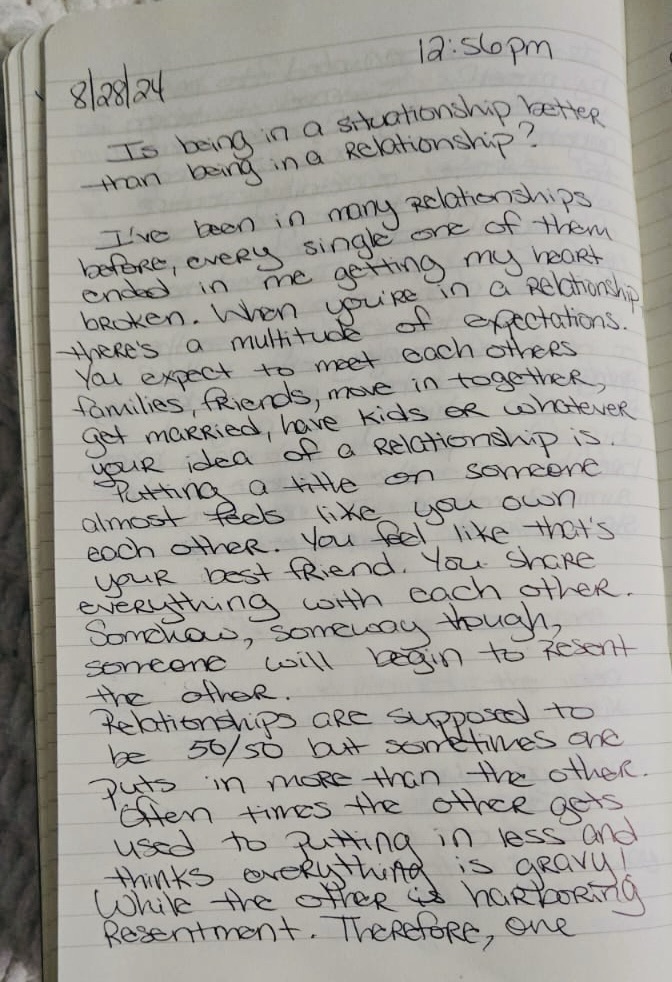
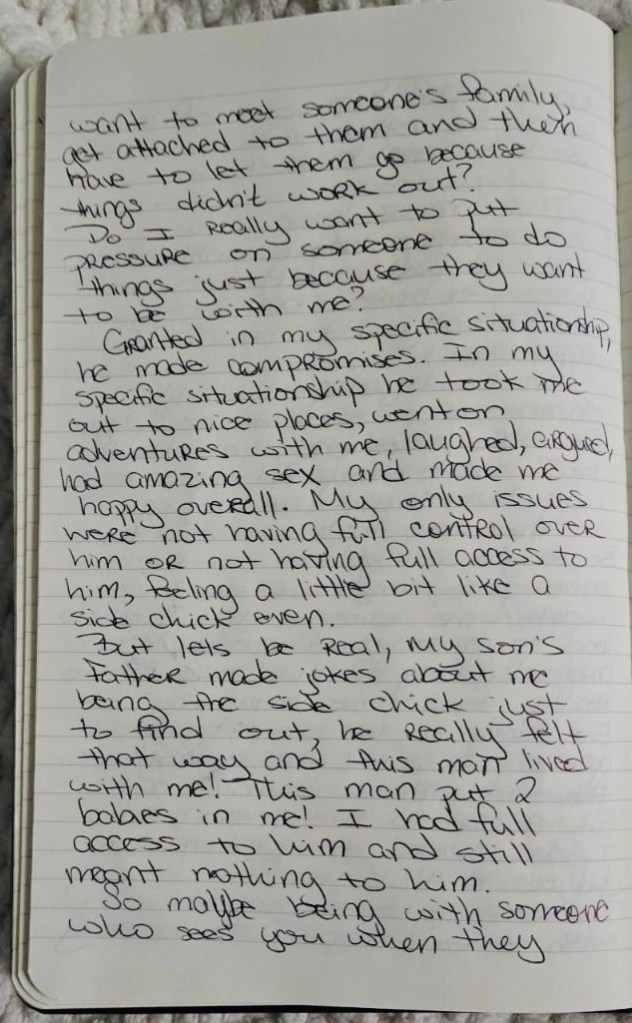
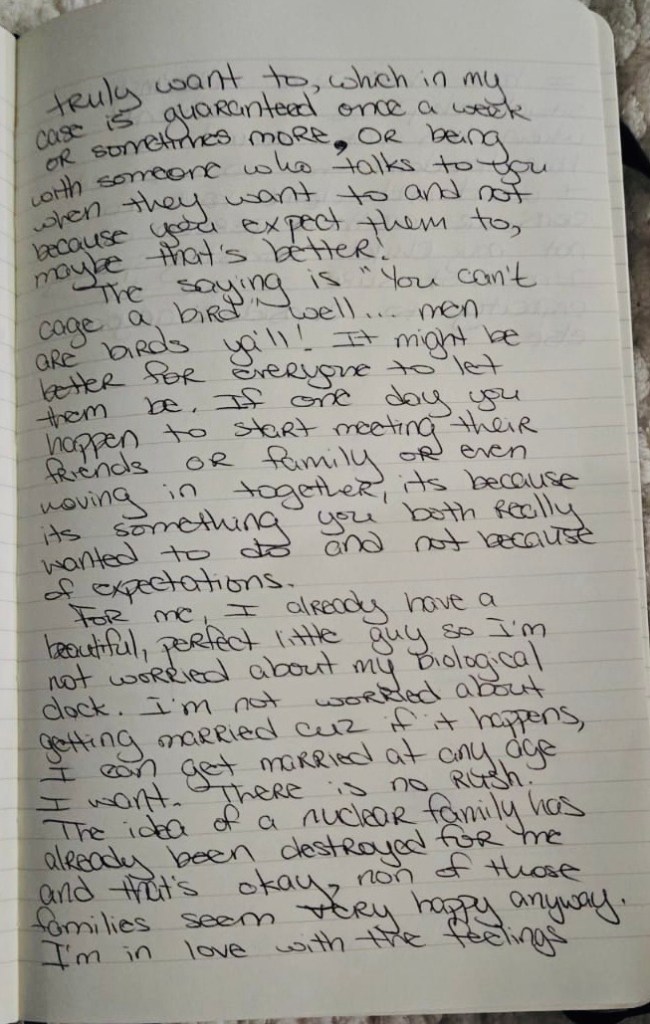
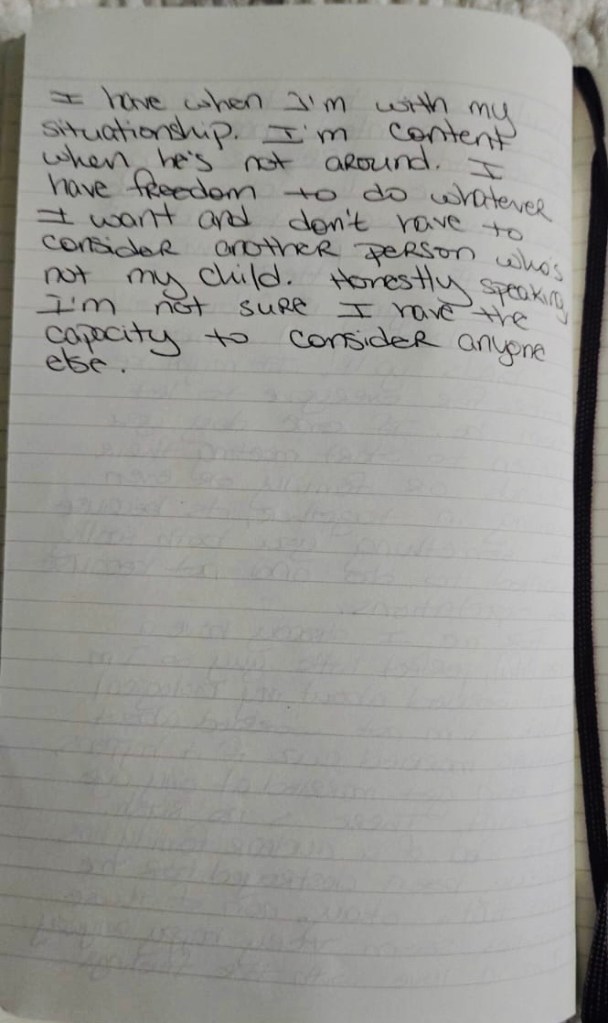
My friend showed me her journal entry about her mental struggles adapting to a situationship. She had allowed me to post the journal entry anonymously, and I will write my responses below the pictures.
I love this journal entry from my Friend, because it’s talking about something that is so foreign for some people, yet so common for others. The new norm of dating has turned into what people are calling situationships, and sometimes; delusion-ships. I tend to call them: The “Gray area” relationships. Meaning, the “Non nucleur” or “Non labeled”, “non titled” romantic relationships. It’s not marriage, it’s not engaged, it’s not “boyfriend or girlfriend” labeled, but … it’s NOT nothing either. There’s a connection. Dates. Maybe some romance. Maybe some fun. But is it simply “F@&k buddies…?” Nope. Because the rules of “f@&k buddies” are typically “sex only”, nothing else.
Many are theorizing that the new norm of the Situationship is a result of extensive childhood and relationship traumas. Not to mention the technological advancements of dating apps and social media. This has resulted in us learning a lot more about infidelity, and manipulation tactics that we should stay away from if we want to be emotionally safe in a relationship. Many more people now fear permanency and over commitment. However, it is still a natural human instinct to need connection. But, more people are realizing that romantic connection doesn’t necessarily mean the relationship has to turn into living together, talks of marriage, or even labels.
From what I read in the journal entry, my friend is now learning how to appreciate what is called the “ebb and flow” of love. The way it moves in and out of our life like an ocean wave. She’s also understanding that she cannot necessarily capture the love and trap it. Because it is not hers to catch and trap. Her situationship person has to voluntarily decide to give it to her; if that is what they want to do. She also reflects on how trying to capture and trap love and confine it by rules has caused more harm in the past than good. Whether this Situationship is forever or just temporary, I can see that there is growth in her emotional processing and in her thought process.
Another key take away, is that she almost did have the “nuclear family”. She wrote about the time in her life where she was living under one roof with the father of her child, and their baby. The “Norm”. The “what people should aspire to”. With the rules, and boundaries, and non negotiables, and expectations. Yet, it wasn’t forever. And many other people that go above and beyond this and get married, still suffer through divorce. Many before us and many after us will.
What we see through the experimentation of loving intimate relationships, is a bunch of humans trying to trap their love with rules and expectations. All the while maintaining the belief that it (the new relationship energy) will be permanent and forever. And though “forever” is technically a choice that two or more people have to make day after day, emotions and feelings aren’t a choice. Meaning, we cannot force someone to love us. We cannot force someone to stay in love with us. And a human cannot force themselves to love when they don’t feel loving. Hence, why we also see many miserably married couples that just refuse to divorce no matter how much it kills them inside; it’s to maintain the “permanence” and the illusion of a “happy forever marriage”. Or perhaps they value the concept of “forever marriage” more than they value their personal happiness.
Do I actually believe in happily ever after marriages? Sure, anything is possible. However, I do believe that it is extremely rare, and I don’t believe that everyone is actually meant for marriage. And in this case, the option of the situationship might be beneficial for those that do not fit into the nuclear category. After all, who are we to judge what “feels right” for someone else?
I’m half awake. Only half at play. Only half yours. Only half this day …will be mine. Only half my mind. Only half my fears, just half this body …. is here. I’m for the sky’s. My true demise… is my soul is gone. But the flesh is fine. How am I still awake? Haven’t I learned to pray? Why fear what’s next… When I’m already gone? -EaE
It’s a brand new cranky wake up every morning. Another Ground hogs day. Repetition. I feel paralyzed upon waking up. I’m angry. I dread it. I’m somehow shocked at how I feel, even though it’s always the same. My mind runs through the same pessimistic thoughts despite the fact that I’ve worked through cognitive behavioral therapy since my early 20s. Im groggy, sometimes dizzy. I hit snooze 1 or 2… or 3 times. When I force myself up for work, I can’t control my muscular motors very well. I walk into the walls and doors. I brace myself with the walls so I don’t fall over completely. Everything I do feels forced and painful. I rush out the door late most days. It will be hours before I feel awake. And that’s always a maybe. Some days I won’t wake up fully.
Yes I have experienced this after 4 hours, 5 hours, 6 hours, 7 hours, 8, 9, 10 plus. Yes I have also experienced this regardless of healthy eating vs junk food. I experience it regardless of how little I workout or how much I workout. It does not matter, it makes no difference. It’s called hypersomnia, I was diagnosed in my early twenties. And it’s a condition that’s heavily linked to major depression. I get tired of the “good mornings” from coworkers. I do have the privilege of an office now though. I can try to hide from them. But then there’s the patients! Waking up for primary care patients by 0800. This sounds whiny and yet, Im just telling the truth. I really want to be able to wake up, but I don’t get to make that choice my body and brain chemicals do.
Then there’s the workout or martial arts after work. By then I’m typically only half awake. I either woke up for a bit and crashed, or never fully woke up. Sports are more dangerous when you are fatigued. Especially a combat sport. I have to be careful and put my ego aside and respect my limitations. My BJJ team is made up of strong athletic and explosive military men that wrestle me on the regular. If I’m not sharp or cautious, I could easily get injured.
This was only recently validated for me when I talked to my cousins again in Texas earlier this summer. Everyone in my family has a sleep disorder. Some of us are nocturnal, some night owls, some have Narcolepsy, hypersomnia and / or insomnia. My dad also has sleep apnea! I was so proud of myself and my cousins, how our generation is finally starting to talk about our mental health struggles guilt free. We talked about how hard it gets to ‘wake up’ for the 9-5 lifestyle: just trying to get through the day. And some of them have kids too! For a while, I used to describe hypersomnia as ‘being on half empty’, however, that makes it sound like the issue is being ‘low on fuel’. Fuel has nothing to do with it. Now, I’ve realized the more appropriate way to explain us is as people that are ‘only half awake’.
Anytime I talk to clients, friends or family that have hypersomnia, I have also noticed a theme. A theme of everyone wanting to ‘escape’ life through sleeping. Sleeping is the ultimate escapism when you may not want to be awake, living life day to day. It doesn’t necessarily mean suicidal, but it means there is an extreme exhaustion when it comes to living life. The art of ‘waking up and doing’ is exhausting. Something in our brain ‘does not want it’, and would prefer the sleep instead. It could also explain why our (hypersomniacs) sleep is ‘never restful’ and rarely restores our energy levels. The mental component could be the perpetual thought patterns of dreading the day and the exhausting work that the day might require.
Giving ourselves Grace
Just like with any medical or mental health condition, hypersomnia requires that we give ourselves grace first. Recognizing that we have a condition that is not our fault, and often times out of our control. Recognizing that there are limitations that it causes; leading to grief of ‘what we could be doing’ and accepting ‘what is’. Deciding if medication (whether prescription or holistic/ herbal) is the right step for us; weighing all the pros and cons. Picking our jobs or lifestyles with the condition in mind, as to not exacerbate it (I myself am not doing well with that as I work in primary care which always has an early morning start).
Dealing with Peer judgement/ Stigmas
Like any other physical or mental health condition; people don’t understand it unless they have to live with it. With that being said, you are going to get a ton of unhelpful comments and/ or advice from friends, family members or work peers. To be honest, I usually avoid talking about my mental health problems for this very reason. Educating people can be exhausting. So, I prefer not to mention anything at all. However, it’s hard to avoid this in a job. Your coworkers or boss will likely notice how tired you look, every day. They will eventually get concerned and teach you about their sleep hygiene routine’s, diets etc etc. You have to smile and nod. Or you can explain that you have a condition but that is 100% up to you. Also, they may hear it, but not believe it’s real.
It gets Superficial too… unfortunately
Before I learned how to properly do my make up, I used to get comments allllll theeee timmmmeee. It usually went something like this (on a rotation): “Are you okay?” “Are you sick?” “Are you tired?” The dark circles under my eye’s do not go away. I was tested for anemia and thyroid problems, and both tests came back wnl. I was also tested for sleep apnea; it came back normal. The fatigue and dark circles have been prevalent since I was 5 or six years old. I don’t wear makeup to be cute. I literally wear makeup so that people stop asking me those questions. (And sometimes looking cuter is a bonus)
Coping skills
Surrounding yourself with the friends and family members that are empathic helps! (My ex Fiance used to force me up early to go hiking with him in the freezing cold to ‘cure me’. It was horrific and led to us getting in some serious verbal altercations. Sleep affects mood, mood effects sleep. Don’t let anyone mess with your sleep.)
Sleeping in shame free. We may need to catch up on sleep. Or we may need days where we naturally get to wake up without an alarm. (Due to depression and hypersomnia; my body tends to want to naturally awaken, slowly get up, move slowly until the middle of the day. My energy peak does not happy until evenings or nighttime. Hence, why I strictly workout in afternoons vs mornings. Forcing a hypersomniac to wake up and workout is hazardous!)
Workout regardless. I know it sounds like a soapbox, but it’s just true. Human beings need movement. A large perpetuating factor of depression is being too sedentary due to our fatigue, and then we become more tired. Then the pounds add up, then workouts become increasingly harder, then the shame. Vicious cycle. But here’s the thing; pick whatever the heck you want! Walk/ hike, or play a sport, or lift, or pole dance, or do martial arts, or play golf, or Pilates/ yoga, have amazing action-packed sex, swim or go climb things. Whatever in the world you want to do to move your body, go for it. Pace yourself! Because you are only half awake.
Recently I noticed the viral TikTok videos of people posting their cats or themselves with their cats in response to J.D. Vance’s rant. I’m not one to dive into politics. But following this incident, I decided to do a little bit of social media research. I created a Facebook poll along with story posts on IG and FB inquiring for DM’s and feedback. I also made a permanent Tiktok post asking single cat people if they are happy or miserable and encouraged them to comment their experiences. I wanted to research qualitative and quantitative findings regarding this new single person cat epidemic. Are people miserable when they live solo with their cats? Are people pretty happy with it? Are they neutral? What does the general public have to say about this? Hearing from regular people is just as important as hearing the opinions of politicians, if not more. Below I will share what little bit of research I was able to conduct in the past week. In the interest of all participants, I will keep everything anonymous.
The Methods:
Facebook Poll: I chose a private Facebook group. Facebook Group Name: ‘A group where we talk about everything’
Group participants were asked to select if they are A: A single cat person that loves life B: A single cat person that’s miserable or C: In a relationship. I left the poll options open so that participants could add more. So now, I will share the add On’s that people elected to use. D: Dogs are better E: Widowed cat person now miserable without my other half (Damn…) F: Married, no children, but love my 2 cats (They could have just said they are in a relationship, technically they meet criteria for C) G: Happily taken cat person (Again they meet criteria C) H: Multigenerational home with 4 cats, happiness is on a day by day basis I: Married childfree cat person (Criteria C yet again, but hey people love to talk about their specific situations, so I get it) J: Happiest ever! Single, no kids, cat and dog person (This does meet criteria for A, they are single and happy with a cat, and a dog. So, still happily single with a cat, technically) K: A ❤ emoji along with 2 cats… (I imagine this meets criteria for the A category if I’m deciphering the picture correctly!) L: 2 Cat emojis > Politicians (That’s just stating facts….) M: R ehe Cat (I believe this person must have had a stroke while typing) N: And the cats in the ladle at the peking Moon…. (They might have been high…. )
A- 23% (30 Votes) ” A single cat person that loves life” // B- 1% 2 Votes A single cat person that’s miserable // C- 13% (18 Votes) In a relationship This is my initial Poll. Now let’s lump together the Add ons:
A (Along with Groups J & K) J- 1 vote K- 1 Vote Option A= 32 Votes in Grand total: Single Cat people that Love Life
B(Along with our poor widow that is grieving and has her cat) – Add one vote to our two B Votes Option B= 2 Votes in Grand Total: Single Cat people that are Miserable
C(Along with Groups F, G, and I) Add X% of all people polled that are ‘In a relationship” AKA NOT SINGLE Group F- 3 Votes Group G- 12 Votes Group I- 2 Votes. Option C = 35 Votes in Grand Total: People in relationships; most with dogs and cats, some without
The Math aint mathin? It’s also because I had to leave a few things out due to some poll selections not answering my original research question. I am not a mathematician, but it is only ethical that I disclose what was left out. I left out poll results/ votes that I found would skew the research due to no relevance to the research question. 23 Votes: People that were confused by my research question. 13 Votes: People that voted to ‘rephrase’ the question. 18 Votes: Dogs are Better. (This is opinion based and does not answer my question) 2 Votes: Illiterate or nonsensical poll options that had no relevance. That’s a Grand Total of 54 Votes that I could not put into my research poll findings. 69 Votes were used. Which essentially means this poll is half Bull shit.
My findings & conclusions on the Quantitative data: I have poor grammar or sentence structuring… potentially. Many did not understand the poll or question. Or perhaps, the average person is now illiterate. Also, the conclusions indicate that the majority of people that have cats, whether they are single or in a relationship, are generally happy. So, cat’s make people happy. Single or not. Which means, single cat people are not necessarily unhappy. It would be a mistake to assume a single cat person is unhappy. I did not vote in this poll btw. I am a single cat person, that is a mix of many emotions. I would have potentially skewed the results as well.
TikTok, Instagram and/ or Facebook Qualitative Findings: I posted a mix of stories & permanent posts to inquire about people’s ‘single cat life’ happy or not happy? I received both public comments and private Direct messages online. Qualitative findings will be shared in quotes. The specific Question: Is anyone really significantly unhappy and devastated about their single cat lady and cat man life right now?
Tiktok feedback in quotes:
“Nope. Accepting my circumstances and accepting maybe I won’t find ‘the one’. Gotta keep working on myself before I allow anything like that again.” (Cis Male)
“You have one cat, not 86 cats” (A friend reminding me that I have only one cat, so i’m not a crazy cat lady. Thanks buddy!) (Cis Lady)
“I’m not single, but I do have cats” (Her BF probably doesn’t make her happy… she needs the cats too) (Lady…. gender identity & sexual orientation unknown. I just made an assumption and went with it….. oops.)
“Being in relationships is what’s sad. I like being a single cat lady.” (Lady)
“I’m single but waiting to retire to get some cats so they’re not home alone all the time.” (Literally a person that’s thinking about cats upon retirement more than vacations or anything else!) (Gender & sexual orientation unknown)
“No we aren’t” (Lady)
Instagram feedback in quotes
“I won’t do relationships. I feel at this point in time in my 30’s relations for me are over. I just depend on me and only me. I have a dog that plays Non stop.” (Cis Male)
“I choose cats because they do not lie in order to cuddle with you.” (Cis lady)
“I’m just healing from a hell of a marriage. So it’s just me getting my shit together and my sweet little kitten. Im finding comfortability being alone.” (Cis man)
Facebook Feedback quotes taken from my Poll above! (Because yes, these people didn’t just vote, many commented under the poll. The qualitative findings are just as relevant)
“I’m unhappy because I don’t have a cat”
“Not single, still a cat person. happy because I have a cat, unhappy because I can barely afford to live in the current economy.” (It can be concluded that cats make us very happy…. even when we are broke AF)
“I am a single cat person. My life is in shambles and not in a good place, but I am happy to be single. A partner would make it more stressful; I don’t need that.”
“Why what? Do you mean why am I happy? I do whatever makes me happy; then I come home and see my cat!”
“I have 6 cats and after being dumped via snapchat by someone allergic, I’m sticking to cats to snuggle with at night.” (Girl you might have too many cats….)
“I am newly separated with 15 cats in my house. 6 of them are 3 weeks old and their scary feral Momma” (Wut??!!!!)
“I love cats, but my career is with dogs. I’m in a relationship now but was single and happy as a clam for 7 years before. And the whole government can go suck it’s own butt.”
My conclusions with the qualitative social media findings: Many people are HAPPY as hell living single with their cats. Or, they are grieving in a healthier way, with the emotional support that cats have to offer. Now, there might be a few people out there that are single because they have too many cats. But, if they would rather have cats than people, it’s really a non-issue. Relationships and/ or marriage is not completely dead. But even many of the married people have cats. Cats will often fulfill the needs that your dusty spouse cannot fulfill. And yessss, dogs are adorable too.
Suggestion after my Research: Adopt More Cats. And don’t be afraid of single life.
Ironically, my cat almost sabotaged this entire research blog by stepping on the keyboard! But, he’s too cute and I can’t be angry. My goal is to adopt a kitten hopefully by the end of the year! 🐈 That should keep Lynx entertained.
My trauma puzzle poems take you through my life from the ages of 3 y/o to roughly 22 years old. It’s the perspective of what I witnessed, felt and thought about through the majority of my childhood traumas. I keep an element of mystery because 1- it’s not always about EXACTLY what happened to us, it’s also about how we perceive it, interpret it and feel about it. The adults in my life had their own battles going on; some of which I know nothing about. 2- I also prefer that the readers do their own interpreting of my writing. ✍️ PTSD is very much one of those mental illnesses in which you either understand it, or you don’t. You have to live with it to really understand how the condition impacts day to day reality. Sometimes it’s pointless to explain it in “psychobabble terms”, and more beneficial when/ if I can help people feel it. Especially if the poem offends you, or invokes an emotional response in any way, perhaps it’s because we share a similar trauma.
Two weeks ago, I flew back to Houston to Honor my grandmother (Gram) for her 95th Birthday. We must have talked at least 10 times this year leading up to the Bday celebration. Anytime I reminded her that I would be ‘seeing her soon’, she would say: “God Willing”. And, then it happened! First, Gram did not want a party. She broke her shoulder last year and has not been feeling up for much lately. We understood. The family was attempting a restaurant get together the evening before her Birthday to catch up. Then the plan was to visit Gram at her house in spurts, on her actual birthday. Well, she may be 95, but she has not given up. She decided at the last minute of her Bday Eve, that she wanted to go to one of my cousin’s houses to visit with the family. We all followed suit; ditched the restaurant reservation and met up at Cousin J’s house in true Escalante fashion. Potluck style: with Gram, Uncle’s, Aunt’s, and too many cousins to count.
I lived with my Gram for five years; ages five to ten years old. She was the first stable Mother figure that I had. She was always kind, she did the right thing, always lived by morals and values. She also modeled healthy behaviors. She was always reading, writing, dancing, cleaning, moving etc etc. She raised six children and then raised my brother and I for five years. I think that grandparents that come out of retirement to help raise their grandkids are some of the most badass people on the planet. Through the years, I have always listened to her stories. Every time we talk, she repeats her stories. And even if I had heard the story hundreds of times, I will always listen to it as if it is the first time I have heard it. Today I want to discuss some of the more common themes that come up in conversations when we talk to Gram.
Her Husband (My Grandpa) Gram will always remind us that her mother always told her: “Don’t get married, men are awful”. My gram did not marry young, she was 25 when she married, and had her first born. (A Honeymoon conception as my Aunt calls it!) And ‘back in her day’, that was all a late start. What changed her mind and made her finally decide to marry? My Gram says that Grandpa was a ‘funny, silly, goofball man, always making jokes’. She founds this to be less threatening than the traditional ‘machismo Mexican men’ that her mother described. They had six children; my father was baby # 2! 🙂 Unfortunately, it was not an easy ride; Gram often talks about Grandpa’s gambling addiction. It seems to still be at the forefront of her mind; and Grandpa died 35-36 years ago; not long before I was born. I do wish I could have met him. It was a roller coaster love story from how she describes it. And she never did remarry after him.
GramsBrothers My Gram has an extensive trauma history, this Include’s three of her brothers getting murdered. And the other brother she was closest to, getting deployed while in the Army, and reaching out to the family with depressing letters. Gram recalls being the only one of 5 girls (she had four sisters) to write him back. She was the one that was always there for him, and being the eldest girl, she was always playing third parent to her entire family. Well, her remaining and closest brother remembered this and gave the majority of his savings to her in his will; following his death due to cancer.
Grams ‘Greedy’ sisters Unfortunately following my Great Uncle’s will, several of my Gram’s sisters took her through a long term, difficult, chaotic, expensive legal battle. To this day, her sister’s hold a grudge on her due to not getting more of their brother’s savings. Its unfortunate how families can become so divided over money and inheritance. Deep resentment broke the blood bonds and family ties that they shared.
Her Parents and PTSD It was only 5 years ago when my Gram shared the traumatic story of how she lost her own father; suicide due to suffering from cancer pain. She more recently shared her experiences with hearing the domestic violence between her Dad and Mom. And her Mom? ‘Never hugged her or showed her affection’ but showed her kid’s affection. Gram followed suit. She was not super affectionate to her own kids, but very affectionate to her Grandkid’s; Me for example. Everything collectively added to her PTSD. It collectively built up to the point my Gram ended up suffering from Agoraphobia; a deep fear of leaving home. Gram does not like going out to places besides the grocery store. Even something as simple as me going to a gas station will make her nervous, and she will proceed to tell me about the latest news she read of someone ‘getting murdered at a gas station’.
The Comparisons Gram is 95 years old, she has so many stories to tell. Another theme I have noticed, is that since she has lost soooooo many people (I can’t even imagine her grief! 😦 ) she has to find some way to keep it interesting. Gram likes to point out comparisons to help herself feel more positive. Such as identifying people that are younger than her that ‘look older’. People that are younger than her but need more ‘walking aids’ or ‘medical attention’ than she does. People that have died at a ‘younger age than her’. And she loves to recall how ‘skinny her waist was’ even after so many kids. She loves when we browse her photo albums and look at her curvaceous figure and impeccable fashion sense through the decades! 🙂 (See picture 4 & 5 below for a couple of awesome examples!)
She ‘Doesn’t have Sex, she has a Caregiver!” My Gram’s live in boyfriend… I mean… caregiver Ricardo. They actually met when I was 9 years old and still living with my Gram. I have wonderful memories hanging out with both of them (even catching Ricardo go in for a kiss at the park when they thought I wasn’t looking). Anyways, he moved in with her in 2000 right after my Brother and I left to CA to live with my Dad again. But, they ‘never shared rooms’. And, whenever I asked how Ricardo was doing, my Gram always blurted out “We don’t have sex! He has his room, and I have mine”. But now a days, she is describing Ricardo as her live in ‘Caregiver’. Yes Yes, Gram, your Boyfriend/ Caregiver! 😉
Gram/ Meemaws 95th Bday Celebration The follow up party with more cousins at Grams house the very next day ♥️ Me and the cousins at drunken karaoke night on my last night in Houston 😏🙃😢😭Gram with Grandpa; matching outfits how cute 🥰 She has always been a fashion icon ❤️ Having her Cake & coffee the day after her 95th Bday with the Mug I sent her. Practicing her grammar still ♥️