Prevention is EVERYONE’s Responsibility. Every. Single. Day.

Elisa a. Escalante/ LCSW/ 5/27/2022

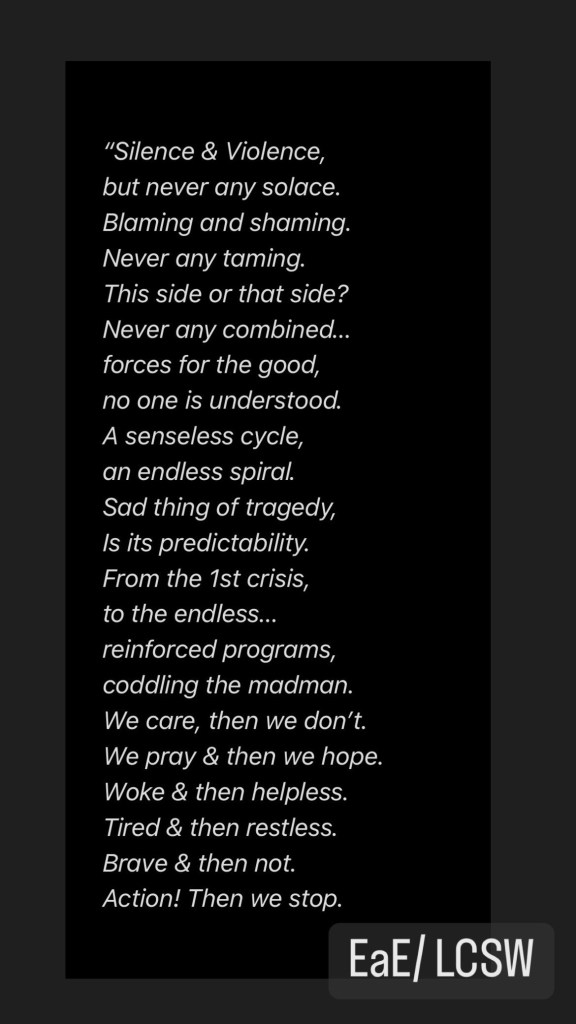
Though I’ve worked with people on an individual level for most of my career, we clinicians, tend to also notice things on mass scales. There’s individual think, and group think. Individuals have themes and thinking patterns, as do the masses. Naturally, after a crisis, many will go into psychological defense modes that are meant to protect and nurture their pain, grief and trauma. Beyond that, we have ever-growing polarization. People must flock to their social media accounts to not only express grief and remorse, but also get ready to combat up into their keyboard warrior mode with a goal of defending the policies that they know will be attacked. Because with tragedy, comes shock, then a want/ need to fix, then opinions, then fighting. Quite honestly the cycle has gotten so predictable, that it’s hard to continue watching.

       But I want to take the time to talk about something that really matters: PREVENTION. Prevention is NOT just about “What law is going to change?” Or “What is THAT person going to do about this problem?” Or “What programs should THEY put in place?” These phrases are all an example of Deflection, when we strive to push all blame onto other’s and protect ourselves from any blame.

      Prevention is EVERYONE’s responsibility. Every single day. And, if you happen to live in a country that has a consistent problem, then as an individual you must acknowledge you are a part of that problem in one way or another. Prevention, from a mental health crisis standpoint, includes: 1- Having empathy, 2- Not treating people like shit, or being a bully. 3- Listening when someone is crying out for help. 4- NOT invalidating someone when they are crying out for help. 5- Less judging overall. 6- Personal self-care, as well as teaching our youth self-care. 7- Knowing when to STOP arguing. 8- Learning and implementing de-escalation techniques. 9- Fostering healthy boundaries. 10- Speaking up vs being a bystander. 11- Volunteering/ donating to helping agencies. 12- Taking accountability/ Working on your personal integrity.

     The list could go on and on, but the message is that every individual character matters. I’ve seen mental health come a long way in the past 14 years. (Since I started working in the profession) The issue, unfortunately, is that we still choose to be a crisis response country vs a preventative country. We fail to do the things that matter to address ‘in the moment’ issues, and often let it simmer beneath the surface, until catastrophe happens. Then, there is shock. I believe the harder message to put across is the fact that it takes daily action and consistency on yourself, in order to help the masses. When people become so individualistic, they forget they are a part of a larger group: A society. People forget that emotions and behaviors are addictive and contagious. We forget about the trickle-down effect. Or, Ping pong effect; when we bounce our emotions back & forth in a battle.

      Small changes that can make Big Differences:

  • Study Mental Health:   There are a million other things people would rather do, but it wouldn’t hurt to study more on this topic. Our brain is so important to our livelihood, quite honestly it’s shocking that more people do not care about this. The brain is the agent & control center of our daily activity. If our brain grows ill and starts to malfunction, it impacts everything. Yes, including our bodies, the phrase of “it’s all in your head” is quite inaccurate. Chronic illnesses such as depression, anxiety, PTSD have already been proven to release harmful chemicals into the body. Even if you do not have a mental disorder, you absolutely know people that do. Also, it can be you at any moment of any day in your future. Even if you are not genetically susceptible, EVERYONE is environmentally susceptible.
  • Refrain from Judging:       Judging is the psychological ‘go to’ we resort to when we have deep rooted insecurities. It’s the ultimate act of hurting someone else in order to ease your own wound. We are meant to do better than that. When we learn to address our own internal pain, and not hurt someone else, we can then help ourselves while doing less harm to others. If you are judgmental, explore your own pain, because you may be doing long term damage to other’s if you don’t.
  • Do Less Harm:      Doing less harm isn’t just the obvious of: Don’t kill, don’t assault, don’t abuse. It’s also the less obvious stuff. Do not enable, do not manipulate, be honest, do not meddle in other people’s lives just because you think you can or that ‘they will thank you later’. Stop believing you have so much control over others, you do not. Don’t use someone’s pain as your own personal agenda, especially if they did not ask you to. Try to refrain from coming to the conclusion that you are a ‘good person’. Since we’re all human, there is a strong likelihood you may have blinders to some of the harm you do, be brave enough to explore your flaws and how you impact others negatively sometimes.
  • Actually take care of yourself:   This, unfortunately, is something that a lot of us Half Ass. And we believe it’s for the better. People often believe sacrificing their self-care for superficial & materialistic things is worth it. It is not. You run the risk of turning into a half cared for human in a terrible mood that is unpleasant to be around. There is no debate on this. When I am a sleep deprived, junk food eating, no free time having, sedentary human being, I am pretty awful not only to others, but to myself. I’m sure many can relate. When you neglect you, you hurt everyone else.
  • Give Social Media a Break from you:     it’s simple to say take breaks from social media, and the answer of ‘why?’ is pretty obvious. But I also want to frame it in the opposite direction: Social media needs a break from you sometimes too. Are you about to be unpleasant and verbally abuse people all day because something messed up your mood or triggered your maladaptive thinking patterns? We’ve all been there. Unfortunately now, it seems socially acceptable to cyber bully or cyber manipulate. The “Do no harm” concept does not automatically stop because it’s the ‘online world’. There is much harm we can do online, this needs to be put in perspective.  Again, Trickle down and ping pong effects.
  • Avoid talking if you don’t have constructive advice:       People truly underestimate when silence needs to happen. I’ve seen in real life and in the online world, that giving advice has become such a compulsive habit for people. Half the time, the advice is terrible or non-constructive. If you are not a professional on a topic or a mentor of any sort, it is absolutely okay to be a listener, and to practice your empathy skills. Most people need work on empathy. It is, in my professional opinion, one of the most underrated assets humans have. We do not exercise it as often as we probably should. It’s easy to just tell people what to do based on your limited personal experience, it’s harder to recognize that this is a whole person that is struggling, and you may not possess the knowledge or foundation to help, but you can be kind.
  • Quality Solitude & Social time:      One of the best ways to gain back a sense of community, camaraderie and connectedness would be to have more quality social time. This doesn’t mean go out to be on your phone the entire time. It doesn’t mean go out to get intoxicated and barely talk to people. It means quality connection, quality conversation, and enjoyable hobbies with people that have similar interests. Then on the flip side, when you need that time to yourself to recharge, is that quality too? Are you doing things that feed your soul, mind and body? Or are you engaged in compulsive behaviors that simply pass the time, but do nothing for you except long term chronic damage? Every passing moment matters.

Prevention does not mean: ‘to do nothing’ and wait. Prevention means, daily consistent actions in order to reduce ongoing harm.

Are you Over-investing?

Elisa A. Escalante/ LCSW/ 5-23-2022

“Life is too short to wear matching socks” -EaE

Have you ever found yourself spinning in a cycle that continues to fail? You thought you had the formula down, you thought that hard work equated to success, but then again, the success isn’t happening. Or, if it is, it seems to always be at a detriment to your health and mental health. From the moment we are children that can begin to comprehend rules, values, morals, social norms and consequences, we are fed a lot on ‘how to go about making a life’ and ‘a living’. At the same time, these ‘social rules’ and expectations do not take into consideration who we are as a unique individual. The perfect formula for one person, won’t necessarily be the right formula for you. Your parents dream job, may not be your dream job. Your friend’s advice may actually be the worst thing you can put into practice, because it doesn’t apply to you. The lifestyle you are living because your intimate partner insists, may actually be killing you inside. These pressures may lead us toward a lifestyle that is ‘seem ably’ right from an outsider’s perspective, but feels wrong to us on a personal level. This may lead to the risk of overinvesting ourselves into people, places, things and situations.

      Why is overinvesting dangerous? I am not just talking about from a financial perspective, but anything imaginable: our time, our emotional/ mental energy, our physical energy, our resources etc. Simply put, it’s dangerous to wear ourselves out doing things that will work against us in the long run. It’s dangerous to wear ourselves down doing things that are counterproductive and/ or harmful. And even scarier is when we have no idea that we are in this over investing/ burnout/ shame cycle, and our health and mental health plummet hard. I’ve had the difficult but rather crucial task of helping some of my clients come to the realization that they are directing a lot of their energy/ time/ emotions into some things that will get them nowhere. Metaphorically, it’s like being the hamster on that wheel, it’s never-ending because they go right back into the same place, despite the energy investments.

         What does over-investing look like?

In the workplace: The first sign is often the risk many fall into of being overworked and underpaid. It can be extremely disheartening to work a job that just covers all the bills, but there is nothing left over for yourself. The other important thing is to evaluate why this is? Is there any wiggle room? Did you also over invest in material things that are now costing you and making daily life not affordable? Or are you truly stuck with the bare minimum without wiggle room? It’s quite interesting to evaluate what people want vs what they need. American’s, in general, have a skewed perception of this due to heavy advertising/ marketing toward consumerism. The better way to combat this from a psychological standpoint is to pay very close attention to what actually brings you peace/ equilibrium. More often than not, people express it’s the smaller/ free/ cheaper things vs the expensive things (instant gratification). As far as the job itself, can you work your way to something higher paying? Or, at the very least, find a different position of equal pay? Sometimes a change in work can also make a huge difference toward burnout prevention.  

In a Business venture: There are definitely stories of people that invested their all in an uncertainty, and wound up rich. Just remember, this is the exception, not the rule. Also remember, you are only hearing the positive parts of the story, not the terrifying parts. Entrepreneurship has become more common, and there is nothing impossible about it, the issue lies more in how we present it to the world. With this mystical career path comes many myths, perceptual differences, expectation reality mismatches, hopes & dreams absent of logic and more. Life has never been about wanting, dreaming, and then magically having. It has always required us to invest parts of ourselves in exchange for, hopefully, something that has worth. Proceed with caution, study, plan, prepare, take consistent action, have good mentors. And, if you don’t want to put that type of work and risk in, don’t do it! Find a suitable 9-5.

In a relationship:  Sadly, this is one of the more common areas people run a high risk of overinvesting. Society pressures us into marriage and family so often that many of us are at risk of over investing in a relationship that lacks compatibility.  Even worse, some relationships become extremely toxic to a point we may even be investing in our own abuse! The emotional part of our brain hangs onto the highs of the relationship even through the low points, while our mental, physical health and sometimes our wallet starts to deteriorate. Even in relationships, if there is no gain and all investing, we can gauge that it may not be worth it in the long run. The hard part is stepping away from the emotional brain long enough to actually neutrally evaluate what it’s doing to you. If you know it should end but you feel guilty, ask yourself why you are choosing someone else over you? That’s the cardinal rule you have forgotten. (Or may have never been taught)

In Academia:    If you’re racking up a lot of college debt while simultaneously changing majors and setting yourself back more, it’s time to take a pause and evaluate/ reevaluate. Did someone pressure you into college, meanwhile you have no clue what you even want out of life? Here’s the issue: Now a day’s, college is way too expensive to enroll in, and not know what you want. I’m here to tell you, you do not have to do this. What do I hate more than seeing people with heavy student loan debt? People with heavy student loan debt, and still no degree or idea of what they want. Then, no professional career, but rather something minimum wage that they cannot live off of because now they have adult bills with student loans, and barely any income to cover it. What may be better for you at this point? –A trade school/ -Take time off from school to work different jobs and learn yourself while also getting more income to live off of/ Volunteering w/ food and shelter stipends/ -Military (Maybe!)

In a Hobby: Are you miserably in a cycle toward a hobby that’s leading to feelings of fear, resentment, shame and frustration. Let me first ask an important question: “Remember when this hobby was supposed to be for you to have fun?” Why did it become miserable? Did you start to raise your expectations to impossible standards? Are you actually doing it because someone else made you do it? Is it boring now because you got too good at it? Are you no longer challenged so you may need to find a better place of practice, or perhaps switch up to something more challenging? Are you stretched thin and no longer have the time you used to, and yet you keep trying to do it the same amount? If you’re now miserable more than anything else with your hobby, reevaluate, ask yourself the harder questions and make the change necessary for your life. The change may be your mindset, or money given, or time given. This is both circumstantial and personal to you and you alone.

In Revenge/ Justice Seeking:     Did an individual or group of people screw you over to a point your entire life and mind was impacted? Now, all that consumes you (understandably so) is the obsession of making sure they get what they deserve after hurting you. It’s completely normal and even healthy to want justice for those that have hurt you. What’s not healthy, is becoming obsessed with it to a point you put all your time, money and emotions into it to a point you end up more hurt. I had to include this because I have seen this happen; people have taken out loans for useless lawyers and were down tens of thousands of dollars, and still, no justice. Or on a smaller scale, wanting revenge on an ex friend or lover, you put your energy into trying to battle them, they’ve moved on, while you waste your time on someone who no longer cares. Again, an investment is a good one only when there’s a return on it. In some cases, we do not get that return, and then the next step would be to accept this as a fact, start the healing process, and move forward.

Conclusion:

     To conclude, let’s go over what good investments look like. Again, a good investment means there is a good and worthwhile return. This investment could mean our time, money, resources, and mental / physical energies. The follow on return should then be, money, resources, mental/ physical highs, increased knowledge, incredible memories (in exchange for our time) and so on. Nothing guarantees success or failure all the way, so a process of investing and hopefully improving our lives, often requires us to take some time to evaluate and reevaluate how something is working for us. It requires honest internal dialogue as well as constructive criticism from those we trust most.

     Most importantly, you have to do it for you, and it has to feel worth it.

Self Destructiveness Cont…

(Part 2- Reducing Self destructive tendencies)

Elisa A. Escalante/ LCSW/ 5-11-2022

          Following up from the last blog post, you may have been able to gain some qualitative findings on your own self destructive tendencies. Some may have been very obvious, and other tendencies may have come at a bit more of a surprise to you. After all, if something is our normal, it won’t necessarily feel abnormal. Often times, humans slip into patterns of instant gratification as well (even non traumatized people). This means that after we develop self-destructive patterns, sometimes we may get the dopamine rush associated with the habit, making it all the more hard to quit. If something is proven 10 times out of 10 to make you feel really good while you are hurting, it makes it that much harder to stop doing it. The first part of reducing self-destructiveness is to first admit to yourself that you are in fact, self-destructive at times. Then, have the unconditional acceptance of understanding that this can happen to anyone, you’re not a ‘bad’ person, and it’s not about blaming yourself. Often times these patterns start out subtle and grow with time/ trauma/ grief/ stress and more.

          From the first blog, I will relist the Self destructive categories for reference:

  • Self-inflicted Verbal abuse    – Self Neglect    – Self Sabotage  – Heavy drug abuse
  • Compulsive behaviors   -Abusive relationships    -Binge/ restrict/ purge cycles
  • Non suicidal self-directed violence   – Suicide attempts

     Insight into Self destructive patterns:

  • I am, in fact, self-destructive when I engage in the following activities or rituals: _________________________________________________.
  • I tend to do _______________________ when I am feeling ____________________.
  • I want to stop doing/ engaging in _________________________ but I find it hard.
  • Even though I know it’s bad for me, I typically _____________________ because the pro is that I get (to) _____________________________________________________.
  • Some replacement coping activities have worked for me occasionally…. This includes:  _____________________________________________________________________.
  • The long term consequences of some of my Self destructive habits include: _____________________________________________________________________.

      After we gain the insight of what we are doing, the next step is a commitment to change. Quite honestly, this can be one of the longest processes of all. It’s quite fascinating working with individuals and therapy and seeing as they go through what mental health experts call ‘the stages of change’. What often starts with denial turns into an awareness, and from this people move through precontemplation, to contemplating change, preparing, to then taking action. And then lastly, maintenance of the change. From my experience, contemplation is one of the harder stages for people from a mental health perspective. And the, maintenance is difficult from a behavioral and habitual perspective. Contemplation can be time consuming becauase it requires us to run through an extreme amount of emotions in our mind. There is anxiety, depression and grief and maybe even anger.

Common self-defeating thoughts during Contemplation of change:

  • I might not succeed   
  • Giving up this habit of _____________ will mean that I will suffer through ___________.
  • I’ve tried before, 1-it did not work…. or 2- it was not worth it.
  • Will it be worth it?
  • Do I deserve to feel better?
  • What’s the point?

The Commitment to Change

     Commitment to changing self-destructive patterns requires us to start caring about ourselves. How do you learn to care about yourself when no one else did? How do you learn the self-care habits when no one taught you? How do you soothe your emotions through the urge to want a heavy release so that you can go back to life as usual? The commitment to change means a requirement to sit in the distressful emotions you will inevitably experience while you are in the process of change. It means that when you decide NOT to binge eat, you must sit with a void. It means, stop inflicting pain on your body, so that you can deal with the internal pain. It means to stop getting so high, and face sobriety. It means to stop chasing that asshole that keeps hurting you, and face being alone. What does all of the above have in common? Yes, you must face the emotions that come up. Soothe the emotions that come up without all of the temporary distractions that will, in the end, NEVER heal you. And worst, they will make you feel worse in the long run. The commitment to change means to care about yourself enough to not want to continue the life you have as is, because you know it hurts you and you’re tired of it.

              Coping replacements

     As ironic as it sounds to many people, self-destructive acts and patterns, are in fact, coping mechanisms. They are harmful ones. To lower harmful coping mechanisms, we must replace them with (ideally) healthier ones. It is not realistic, practical, or helpful for anyone’s mental health to stop a person’s coping mechanisms and not give them the outlets that can help replace them. Sometimes, no coping is worse than harmful coping!  Here’s an example list of healthier coping ideas: (Many of which help my patients)

-Reading     -Writing      -Workouts      -Talking      -Crafts      -Nature walks    -Camping     

-Cooking     -Learning     -Exploring/ Travel      -Bath/ Shower     -Meeting new people   

-Daydreaming     -Shopping (with respect to budget)     -Swimming     -Games   

-Phone calls     -Spiritual outlets    -Music      -TV      -Peace & quiet     -Comedy   

-Talk therapy     -fishing     -Healthy eating    -visiting a pet store    -walking barefoot

-Organizing     -Coffee/ tea time      -Dating    -Shooting     -Massages

-Sky/ star gazing     -gardening     -Puzzles     -computer time     -Photography

-Pets     -Get together/ parties     -Amusement parks     -Libraries     -museums

-Meditating     -Essential oils      -Decorating     -Mentoring/ coaching -Baking

Concluding Thoughts: Between inactivity & burnout

      A common issue I see with the majority of people is that at some point we get into an overdoing and underdoing situation when it comes to our daily habits/ activities. We may have decreased motivation and experience depressive ruts that lower our productivity. Then, we may feel shame and frustration which leads to overdoing to a point of burnout. Then the cycle will start all over again. When people are picking out coping tools I also remind them to create a routine/ schedule that is sustainable, vs a routine that will lead to burnout and shame. A balanced schedule allows for basic needs all the way to some self-affiliation needs. A day where there is some time set aside for work, some time for social time, some time for solitude and rest. When the urge to self destruct comes up, it’s important to take the time to recognize what is triggering the urge, and meeting the need accordingly. If the need involves alleviating depression, there are healthy copoing outlets for depression. If the need is that you feel lonely, there are healthy ways to socialize. If the need is to alleviate your anxiety, again, there are healthier ways to reduce anxiety. The cure may never be there, but a solid maintenance plan will help reduce the symptoms over time.

Self-Destructiveness

(Part 1- Qualitatively Measuring your Self-Destructive patterns)

Elisa A. Escalante/ LCSW/ 5-2-2022

“In the quest to heal ourselves, we often and unintentionally, hurt ourselves instead.” –EaE

      There are many measures, screeners, and scales we use in the world of mental health, but I recently started to express a concern that the measure of self-destructiveness is lacking. In the age of our society preaching self-care, holistic health and balance, I found myself compulsively reminding people, that first it’s important to gauge how self-destructive someone is. Why? When you tell abused/ traumatized people to “self-care”, they may not even understand what that means. Did anyone teach them? Did they live in a world where they were allowed to care about themselves? Did they develop healthy habits in childhood? Or, were they left to fend for themselves as children, and in turn, had to pick up on some habits. These habits may have been acts that would ‘sooth’ them in the short run, but harm them in the long run.

     The most important take away is that we start to understand that self-care, is not an innate and natural thing for people. We are born helpless, and in need of help to survive. We are completely left at the mercy of our caregivers. And caregivers, as we know, range in what they are capable of, and what they are willing to do for us. This has a lot to do with what we will then learn to do for ourselves (or not do) as we grow older. Part 1 of this blog is about asking questions and helping people measure and gain an understanding of just how ‘self-destructive’ they are in daily life. Then, in part 2, I will go over interventions and ways to reduce self-destructiveness, for those that are in need. For this measure, I will not be using numbers or getting anyone caught up in being ‘evaluated’ and assigned a percentage. I will simply put the self-destructive categories and questions out there for you to answer yes or no to, and go in as much or as little detail as you would like at this time. This is for people to learn about themselves, and its judgement free. As you get to decide if you ever want to share these answers with anyone.

Are you Self Destructive? (Answer and reflect on the Q’s below)

  • Do you suffer from Self-inflicted Verbal abuse? Do you verbally abuse yourself? This can be a result of having verbally abusive caregivers, either that you were the victim of verbal abuse or perhaps witnessed caregivers verbally abusing each other. This could also be a result being a victim to a lot of bullying in school. Verbally abusing yourself looks like: Name calling, belittling, self-shaming, self-guilt tripping, perfectionistic language etc. Do you find that you are doing this on a regular basis? Even daily? This internal dialogue can start to feel ‘normal’ when it becomes a habit. But, it’s not normal or inherent. Humans do not naturally verbally abuse themselves. Often times, our inner critic dialogue comes from our external critics.
  • Do you suffer from Self Neglect? Do you ignore important humanly needs such as your physical/ medical needs, emotional needs and/ or spiritual needs? Do you forget or neglect to feed yourself or hydrate? Do you move your body enough? Do you allow yourself to have what you crave in moderation? Do you forget to set doctors’ appointments and/ or go to them? Do you suppress your emotional/spiritual needs and focus in on practical/ logical day to day matters such as work and bills? Do you neglect your home environment and fail to make it a comfortable place for you to live in?
  • Do you Self Sabotage?  Do you often ruin or neglect important opportunities for yourself? Either subconsciously or on purpose? Have you consistently been late or not shown up to important life events such as: job interviews, college finals, anniversaries or other important engagements that could boost/ help your life? Do you want change and yet fear it at the same time? Do you fear change to a point that you may hinder or delay your progress? Have you missed out on some pretty ‘huge’ opportunities due to this fear of change or fear of the unknown? Have you missed out on potentially great relationships because of it?
  • Do you engage in heavy Drug abuse patterns? We all self-medicate, but do you engage in heavy use of harmful substances? Do you find yourself using these substances for any/ every reason you can think of? Such as: celebration, sadness, guilt, anger, boredom, stress and more. Are you experiencing negative consequences due to this drug abuse pattern? Negative consequences such as: financial strain, medical side effects, emotional side effects, strained relationships, difficulty at work and so on?
  • Do you engage in compulsive behaviors that result in chronic negative consequences? These compulsive behaviors could include regular unprotected sex with strangers, heavy gambling or shopping. Other behaviors could include chasing adrenaline filled activities such as driving extremely fast, shoplifting, dangerous stunts etc. Do you find it hard to quit? Do you find it hard to sit with yourself in either the boredom or other heavy emotions of what you are experiencing in the moment?
  • Do you accept and even sometimes chase abusive relationships? Any/ everyone could potentially fall victim to an abusive partner, this is not a blame game. Predators do exist in the world. But this question is tailored more toward people that have a repetitive abusive partner history, with a tendency to go back to the abuse. Or chasing the ‘highs’ that follow the lows of the abuse. Do you find the ‘high’ after the abuse a hard thing to get away from? Does it feel like a magnet? Do you find yourself intrigued by the extreme ups and downs that some of your prior abusive partners offered? Do you feel like you must suffer through it to be ‘worthy’ or to finally ‘win’ the affection you worked/ suffered so hard for?
  • Do you engage in restrictive, binge and/ or purge cycles with food? Do you find that you have a difficult relationship with food? Do you find that it leads to the urge to either restrict your caloric intake or purge what you have eaten? Or do you find yourself binging and then hating yourself for it? Are you doing all of the above or maybe parts of it? Are you obsessing over how you look and how others perceive your looks? Does obsessions with losing/ gaining weight haunt your daily thinking? Have you fell ill due to these unhealthy habits with food or experienced negative physical, social or emotional consequences?
  • Do you engage in Non suicidal self-directed violence? Do you harm yourself on purpose? Not for the intent of dying, but for the purpose of ‘soothing’, ‘coping’, ‘feeling something’, attention and/ or unknown reasons? Do you burn yourself? Cut yourself? Obsessively skin pick? Pull your hair out? Do you binge on drugs? Does it relieve you temporarily but you find that the issues you experience always come back? Do you want to stop, but find it hard due to this coping style now being so ingrained?
  • Have you had any suicide attempts? The question is already there. Have you had attempts? Have you sought out help for this? Have you processed this? Do you find yourself not wanting to die anymore but having lingering thoughts about it? Ideations or even plans?

Conclusion:

This is a heavy blog, please take the time to decompress. If anything stands out and you have a therapist already, I encourage self-reflection, and also to discuss with your therapist in the next session. If you never had a therapist and want to start therapy, that is always a YES answer from me. The purpose of this blog is for psychoeducation, but cannot replace therapy. In part 2, I will break down/ discuss possible self-interventions to combat self-destructive patterns. Stay tuned, and stay safe.

Mental Poetry

Elisa A Escalante/ LCSW/ 4-23-2022

I wrote this in regard to people that were close to me, that thought it was a better idea to lie to me and allow me to live in “blissful ignorance” vs tell me the actual truth. Be honest with your friends and partners, even if it hurts.
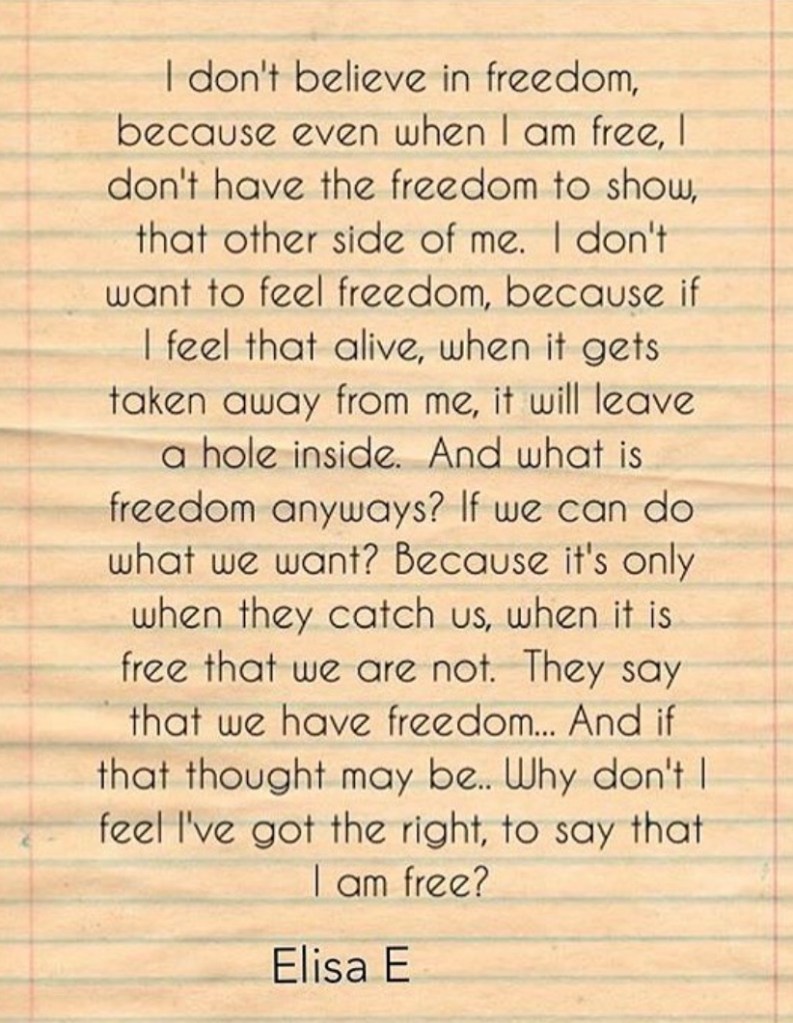
I wrote this way back in High School. Even back then, I felt like freedom was just an illusion .
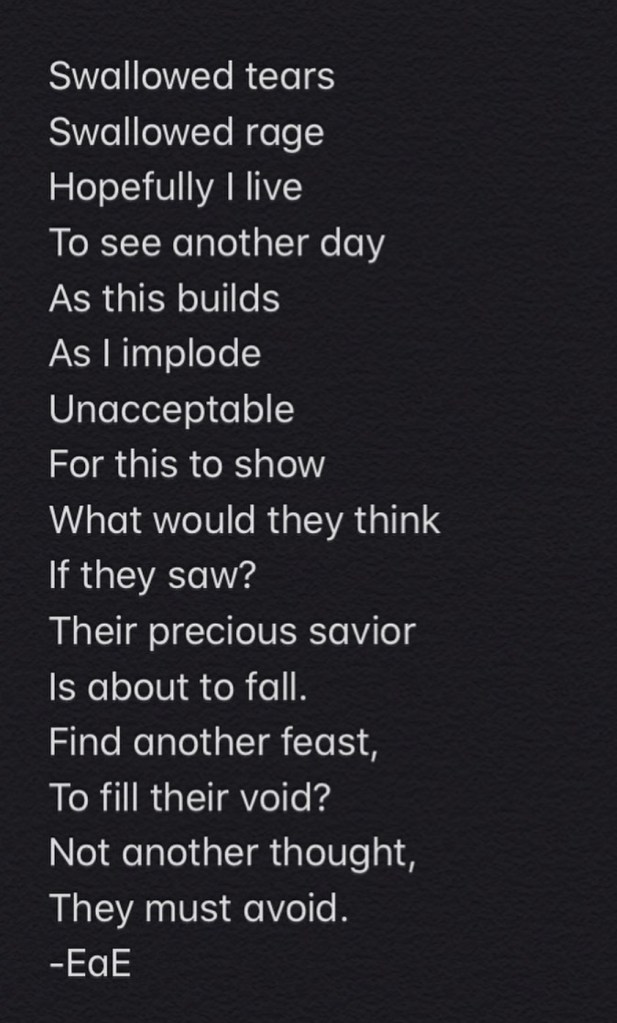
I wrote this regarding the types of people I refer to as “leeches” and “vampires”. People that latch on and take advantage of kindness, without regard to how badly they are hurting us.
This is about drug induced psychosis & ego death
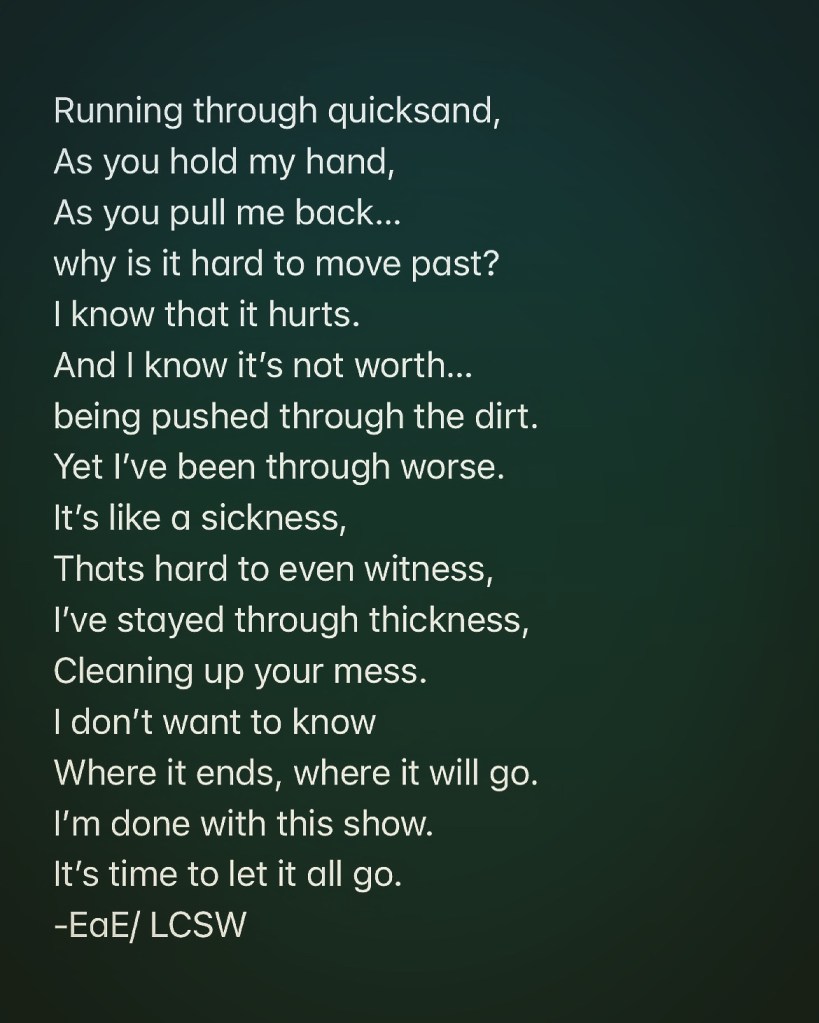
This is about having a toxic friend that holds you back, and the hardship of coming to the realization that you have to cut ties and move on.
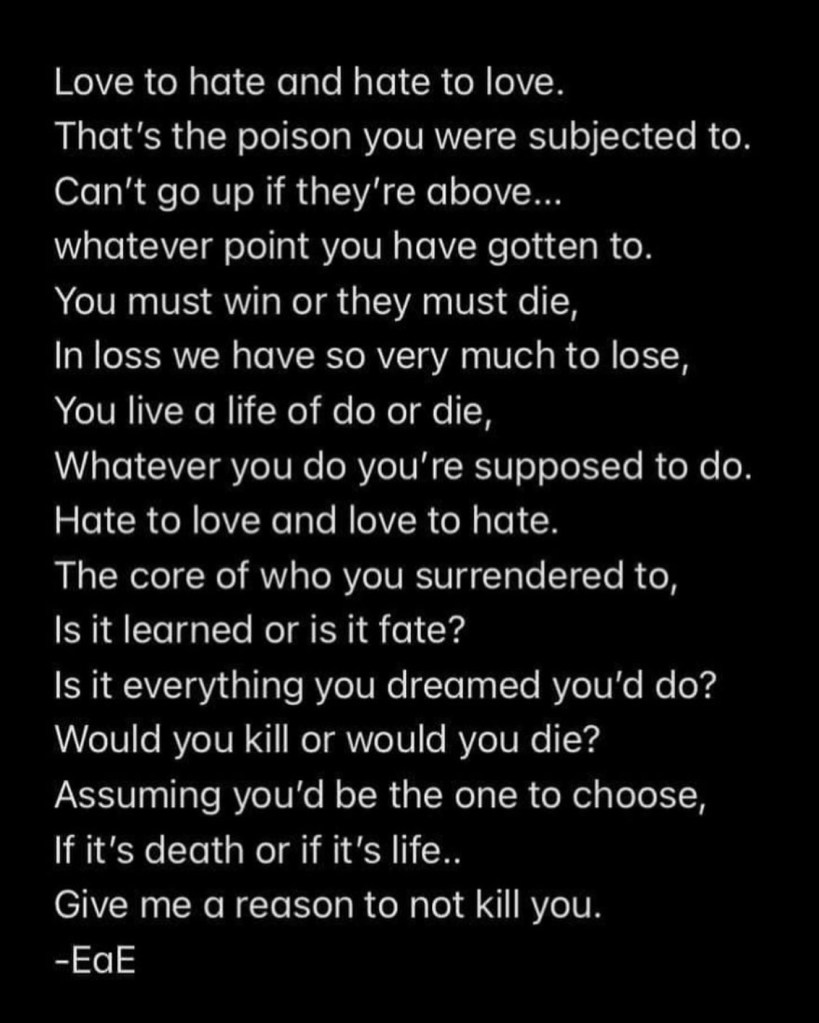
This is about the danger of envy and toxic competitiveness. How some people get to a point they want to win so bad, they would do any horrific thing for it.
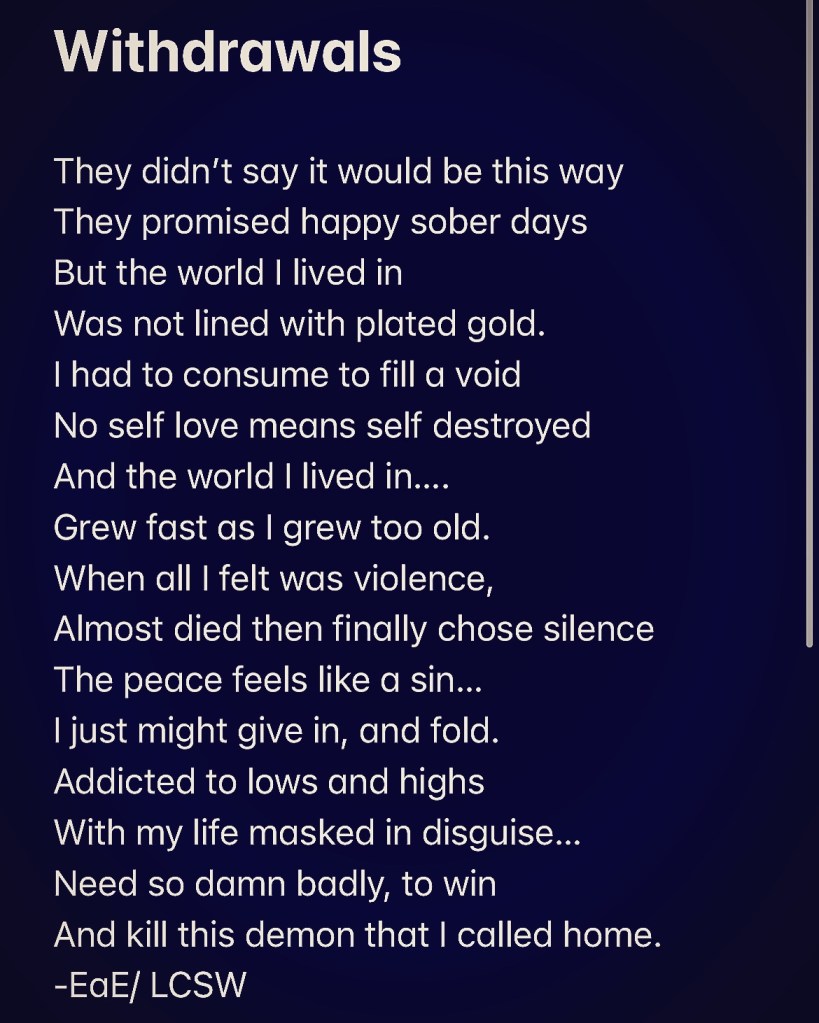
This is about drug and abusive relationship withdrawal. How even though the sobriety of it is better for us, we feel extremely unsteady with our newfound peace.
Many different forms of suicidal ideation, plans and attempts
War trauma, drug addiction, confusion, flashbacks, danger, anxiety, numbness and more

Chronic and Incurable

Elisa A. Escalante/ LCSW/ 4-15-2022

“Life works out better when you can see the purpose in your boring day off just as much as you can see the purpose in your purposeful work days.”

      On one end of the spectrum I, as a behavioral health specialist, may get questions like “So what do I do?” “What’s the answer?” Then, on the other end of the spectrum I may get comments or retorts such as “That doesn’t help!” “That’s not going to solve my problems!” Both sets of comments, whether you’re on one end of the spectrum or the other, do end up pointing to the same issue: Expectation reality mismatch. Somewhere along the lines, perhaps you were led to believe that the mental health world has magical ‘cure alls’, or that life in itself, was not meant to have chronic illnesses. That surely, there is a divine intervention that will fix this chronic issue once and for all…. but then… everything falls short. Or rather, most interventions will offer temporary relief, but will not make the physical or mental ailment go away all together.

     When I entered the world of mental health at the inexperienced age of eighteen, I wanted to believe in this obsession we have of ‘finding a cure’. I wanted to save people, I wanted to believe there were concrete answers to the majority of these issues. But what I came to find was the theme of chronic illnesses such as chronic pain conditions, depression, anxiety, PTSD, eating disorders, ADHD, Bipolar disorder, “personality disorders” (Complex PTSD), addiction(s) and more…. Were in fact, very chronic. I saw therapists at workshops and webinars constantly preaching the ‘next big cure’ for specific mental conditions. Only to see colleagues use these ‘promising interventions’, and to their frustration, many of their patients felt better temporarily, but typically had a new flood of symptoms causing them distress anywhere from month’s to years later.

        Curing should NOT be the goal

       Curing should not be the goal, nor should it be promised by any clinician or person. Why? Because most mental illnesses are in fact, CHRONIC. This means that there is a chance the symptoms may go through waves throughout the course of our lifetime. We may have some really great days, weeks, months or years. Followed by some horrendous days, weeks, months and years. Most clients describe these waves, and that their environment, social situations, life circumstances and holistic health often play factors in how they feel too. As a clinician, I’ve had many cases in which people came to get therapy in spurts, often times based on symptom exacerbation. For example, they may get help for months and then disappear for months, then come back for more help. Why? Simply put, when symptoms get better, they see no reason to get help. They may even go on about life hopeful that the symptoms never resurface, only to find out they often do, inevitably, when faced with life triggers, traumas, grievances and other stressful circumstances.

       The Real Goal: Symptom maintenance

        Because most mental conditions are chronic, the goal is symptom maintenance. First, for some clients I just get through the difficult task of explaining the heart wrenching truth: There is no cure all. I don’t have the divine intervention, I have many interventions that can help temporarily alleviate symptoms, but nothing that cures and makes everything go away. And since mental health is not just about biological susceptibility, but in large part, environmental and social factors play a role; how can we ever expect a cure?? Does life stress ever actually go away? No, if anything, hopefully we learn to tailor our lifestyle according to our needs/ desires. The goal of symptom maintenance requires that we get therapy in spurts over time, take what works, and discard the rest. Rinse, wash, repeat. Gain the knowledge, practice interventions, find the tools that work, practice self-care daily if possible, and treat therapy as a marathon vs a sprint. If you try to sprint through therapy, what you are going to find is that you might learn one half assed intervention, and find that it barely scratches the surface of your issues.

       Holistic Health

       Holistic health has to do with the concept that every part of our health and well-being plays a part in how we feel and function day to day: physical, mental, moral, emotional, social, professional, spiritual, financial and more. Most humans will tackle 1-2 of these components heavily in ‘pursuit of happiness’ only to find that there’s a lot missing, there are many voids, and many symptoms that sometimes go unexplained. A balanced individual strives to contribute little by little to all of their life realms, without working to burnout in any category. These individuals, tend to feel better day to day, vs someone that is imbalanced and abstaining from a focus on holistic health. What does focusing on holistic health and balance look like?

         Holistic Checklist:

  • Hydrate, rest, nourish, nurture body
  • Therapy and/ or medication compliance (talk/ nature/ pet/ writing etc)
  • Self Help books/ audios/ documentaries
  • Solitude Activities
  • Social activities
  • Physical activities
  • Intimacy/ Love
  • Spiritual Outlets
  • Budgeting time and money
  • Professional development (school/ work formal and/ or non-formal)
  • Behaviorally activated hobbies (gardening/ crafts/ woodwork etc)
  • Exploring new things/ new adventures
  • Building a comfortable/ sustainable routine

Conclusion:

Here’s what they don’t tell us: Being healthy takes a lot of work, especially as we age. Maybe you have a healthy baseline and the above list simply needs to be maintained. However, many people walk around with an imbalanced baseline. Maybe your baseline is depressed, or anxious, or angry. Therefore, the holistic list needs to be modified and some areas may need more focus than others for a while. Sometimes the priorities must change on our holistic list. I mentioned recently to a patient that was struggling with a traumatic loss that it is absolutely okay and acceptable to switch her priorities for the time being, the situation warrants it. This is never a one size fits all. This is a never ending practice, learning to balance our life and self care routine. But absolutely, never under estimate the importance of it. Also, never let someone make you feel like your holistic care MUST be sacrificed. This is your life, after all.

Mental Health Internet “Experts” Part 2

Elisa A. Escalante/ LCSW/ 4-10-2022

After I published mental health experts, I immediately knew that I would need to do a part two. I had a great reviews, and also my blog could be centered around this alone. Because the Internet is throwing out horrible mental health advice at a pace that cannot be controlled. I have no problem debunking some of this horrible mental health advice, especially when it induces shame in those that are suffering on a regular basis. Because mental health is an invisible wound, people that suffer from it are extra vulnerable to being invalidated, critiqued and steered in the wrong direction. So let’s do better, let’s keep striving to get it right.

Though this writer may have had good intentions, she’s neglecting three very important things. 1- depression rumination, 2- trauma triggers. 3- The art of referencing our past to learn, and hopefully, not repeat mistakes. “The past is gone” is a fact many like to bring up. It’s truth, but memory is cemented (in most cases) forever. Memory serves vital functions. Memory could also hinder our mental health. Knowing our “past is gone” won’t erase our memory. Period.
Unpopular fact: SOME of our problems are caused by a lack of self discipline. And some of our problems are caused by being born in horrendous households we had absolutely no say in. Some of our problems are caused by faulty genetics that we did not ask for. Some of our problems are caused by evil predators that are set on ruining our lives. Some of our problems are caused by our government and society. Individual accountability is important, but it’s just a portion of the pie.
To me, this seems like a cop out for someone that’s afraid to actually be a listener when someone is in distress. And how can we possibly know someone will grow into “the person they were meant to be?” As a therapist, I would never feel comfortable selling someone this lie. This goes under the umbrella of toxic positivity.
Sorry Honest Abe (if he in fact wrote this one) but this wasn’t too truthful or honest at all. If happiness was a decision, I would imagine that close to 100 percent of people in this world would be happy. Happy feels pretty good, while sadness, anxiety, stress and anger suck! I would be out of the job if people could simply choose happiness and then the dopamine just rushes into their brain on command. IF ONLY. I believe people fear unhappy people, because they know how fragile their happy state is, and they fear that the other persons depression will contaminate them.
Becoming a victim of any type of trauma: rape, natural disaster, domestic violence, work centered violence, child abuse etc was not a decision anyone intentionally made. Its pretty emotionally immature to call it “playing victim” in reference to anyone that was traumatized and faced with the fragile process of healing. And yes, we do have to heal. That healing process looks like a roller coaster of emotions, and these emotions get judged, everyday. Especially by those who know nothing about real hardship.
Life isn’t life without stress. Stress is guarantee, stress can’t be avoided. “No reason to be stressed?!” I can’t think of a single human developmental milestone that we go through without stress! 🧐 And as we accomplish our feats and/ or deal with our traumas and grievances, it’s incredibly helpful to have role models and mentors that talk to us about this stress and difficult growing pains. Validate! Don’t deny reality!
Insomnia/ Narcolepsy/ Hypersomnia/ Panic disorders/ Depression/ PTSD/ PCOS/ Hypothyroidism/ congestive Heart Failure/ Type 1 Diabetes/ Increased costs of living/ Employee wages barely rising/ multigenerational poverty/ Family Caregiving responsibilities. This is a list of a bunch of medical, mental and environmental conditions this writer ignored in this post. Conditions that make “simple” things, not so simple. Mental & medical conditions as well as poor economic climate aren’t excuses, they’re reasons. They cause limitations. We have to work hard to create a whole new lifestyle so that the sufferer can learn to function properly once again.

Mental Health internet “Experts”

Elisa A. Escalante/ LCSW/ 3-25-2022

This topic needs to get covered, and I finally got my collection together to make this happen. Now with social media, there are mental health influencers and gurus everywhere. There’s more talk on mental health than ever before. And I’m proud of the younger generation for being more open to discuss it. However, the downfall is how quickly even the terrible mental health messages can circulate. I see mental health quotes going viral all the time, sometimes with inappropriate messages. There’s messages geared toward victim blaming, inducing shame, and showcasing ableism. There’s advice that works for a small percentage of people, but definitely not the majority. And the last thing any mental health professional wants to see is hundreds of years of progress getting washed over by a new phenomenon that is hard to tame/ manage. So I will share my collection of harmful mental health posts/ memes in this blog and give my professional rebuttals.

Clinical depression (Major depression) is a chemical imbalance (low serotonin & dopamine levels) typically combined with the vicious cycle of rumination, low motivation and physiological symptoms to include fatigue, limited energy, drain, numbness. People simply do not manifest these symptoms with their mind. Typically, the symptoms may worsen, they may rarely let up, and the result is the cycle which may include negative thinking patterns due to how horrible the person feels. Although it’s easy for those that don’t understand the condition to use the lines “it’s all in your head” or “you are just making yourself sad”, it’s a cop out for not wanting to gain a true understanding of the ailment.
This one was comical to me. As much as I would love to believe this is true, it can be very misleading. Imagine telling a people pleasing, savior complex having, fawning victim of abuse to just settle for what’s in front of them. A good heart and pure intentions is beautiful, but without boundaries it can lead to chaotic situations. And if someone remains stagnant in their chaos, with the delusion that it will “just workout in the end”, they may be getting set up for a world of misery. Things don’t just “work out in our favor”, life requires work, insight, growth and knowledge.
Not all relationships look alike, and not everyone feels the need to conform to societal pressures. Not everyone celebrates love in the same way. Marriage does not always equate to happiness and fulfillment (just look at our countries divorce rate). And NOT getting married does not mean someone is doomed to a destiny of heartbreak.
This seems like a given… but it has to be said again and again. Memory cannot be willed away on command. Our fight or flight response (in the amygdala) is tied to memory (through our hippocampus) in a primal part of our brain geared toward survival. Let go of what? Crucial Memory? Defense mechanisms? Physiological responses? Adrenaline? Letting go cannot happen without safety & healing, regardless.
There are many cases and scenarios in which this would be the worst thing to do. Such as: neglecting your bills, neglecting your responsibilities. Taking attention away from work when it’s stressful, or your children when they’re acting up. Depriving your spouse of attention when they’re upsetting you, further piling on the resentment. This is blanketed, and rarely translates to how real life plays out.
There are many variations of this quote that have circulated. The main issue with this mentality is that it leads people to believe that feelings and emotions do not serve a fundamental purpose. Feelings give us crucial data that we must interpret. Feelings exist just as logic exists, and we NEED both emotions and logic ….and more. “Stronger” than feelings? Feelings deliver messages, they don’t inherently weaken us. This stigma runs deep.
This is stating and advising the obvious. It’s just negating the reality of what an eating addiction and/ or an eating disorder is. The issue is that there are many that do suffer through the cycle of disordered eating, and can’t seem to gain a grip on managing it. And in cases like that, the sufferers need a well thought out treatment plan and intervention, not a blanketed statement that may induce shame due to simplifying a rather complex problem. The above advice is what a healthy mind would do, not an ill one.
I simply must believe a ten year old wrote this. It’s the only way to keep some of my faith in humanity in tact. Only a healthy kid, maybe ten or younger would think or assume our minds are always in our control no matter what trauma or hardship we endure…. Right?

With Great Power…

Elisa A. Escalante/ LCSW/ 3-20-2022

“Some people will show a fictional version of themselves, with the motive of getting the best they can out of you.”- EaE

Sometimes you do not know the power you possess, mentally. Sometimes our mental traits, defense mechanisms and even disorders, can give us advantages over other mental dispositions. A person with descent morals will recognize their power and take it seriously. An oblivious person may not realize the power they hold as they continue to hurt others. And, an evil person, will use the power to their advantage without a care in the world. These power dynamics can play out in friendships, intimate relationships, family dynamics and work relationships. The off-set balance can give some people advantages that they do not deserve, while other people may get the short end of the stick if their mental traits and character put them at a disadvantage, even when they have good intentions and work hard. In this blog I will discuss what happens when certain mental traits/ personalities fuse together/ join forces but create an unhealthy dynamic that may leave one or more people hurt. This education could possibly help oppressors learn to tame their ability to hurt others and can help victims learn to see a cycle that they may want to get out of.

       Disinhibited attachment vs Attachment Anxious

Disinhibited attachment stems from those that were neglected in their upbringing to a point they learned to emotionally distance themselves and handle life on their own. They learn to not need people in any capacity and can be okay in extreme amounts of solitude. Meanwhile, attachment anxious people have similar upbringings with neglect and abandonment. However, instead of learning to be alone, they went the opposite route and tend to chase and cling in order to get the love they long for. If you happen to be a person with disinhibited attachment, with someone that is attachment anxious, you hold a lot of power. You can be okay alone, mean while the attachment anxious will long for you, and also chase you when you pull away. This can cause a very unhealthy dynamic which may result in serious heartbreak. Some attachment anxious people may even get suicidal if they continue to get into relational dynamics that make them feel ‘unworthy’ and used. Be very careful with this power, and if you are not serious about someone, maybe be honest and try not to lead anyone on. And to the attachment anxious, learning not to chase will be your biggest challenge, but it will also set you free when you master it.

       The Narcissist vs The Savior

Unfortunately, there may be no point in giving advice to a narcissist because the literature will always tell us, that they do not care who they hurt. That is the true power of the narcissist, being able to lie and manipulate and not feel any remorse. This keeps them one step above anyone with a moral conscious. So, this warning is for the savior. Be careful who you are trying to save. Be aware if you have a theme of wanting to rescue others to feel ‘worthy’. You may feel some semblance of worth temporarily, but it will not be worth it. At first, the dynamic of a narcissist and a savior may feel incredible. What does a savior love more than saving and showing someone how good they are? They will get the compliments about how great they are. The saving will get reinforced. But eventually they may burnout and have a lack of appreciation. The true warning sign of when this is unhealthy? When you are saving and saving and saving, and the other person is not reciprocating. Then, when you are fatigued and need a break, if they hate you for it, they didn’t love you. They loved what you had to offer. That is not a collaborative relationship, that is a one-way relationship that only served the narcissist, not the savior. A person that cares for you, will care for your health and wellbeing.

       The Anxious vs the Depressed

 Anxious people tend to live in “What if?” land, meanwhile depressed people live in “whyyy?” land. One obsesses and fusses over everything, while the other ruminates and shuts out the world. Anxious people use the energy to be on ‘go go go’ mode and have the compulsion to control outcomes in order to ease their anxiety. Meanwhile, depressed people are fatigued and numbed out to a point it’s hard to care about anything. These two mental dispositions and belief patterns typically cannot understand each other. They offend each other. The anxious to the depressed: “Why the hell don’t you care about this?”  The depressed to the anxious: “Why do you care so damn much?” In this case, neither are completely wrong or right, neither encompass all the power, despite what some may believe. They’re just on opposite ends of the spectrum, and it may complicate the dynamics of a relationship. As the depressed person, it may be tempting to make fun of the anxious as they ‘care way too much’. Then as the anxious person, it’s tempting to ridicule the depressed person, as they are ‘way too negative’. They both have different areas of power, and different areas of weakness. Empathy please!!!  

       The Blunt & outspoken vs the Silent & Timid

If you are blunt & outspoken and have some type of intimate, family, work relationship or friendship with a shy/ silent and timid type, it’s important to know you hold a lot of power. You get your words and feelings out there, while they feel the need to keep quiet. You may offend them without getting faced with confrontation. They may be burning inside with resentment while you go about life saying what you want. Despite popular belief, quiet people are not necessarily ‘snobby’. In many cases, they were taught to not voice their concerns or stand up for themselves for a variety of reasons. This could include abuse in childhood, cultural teachings, religious teachings and so on. Not all people that are blunt and outspoken are abusive, but for the ones that tend to be, this can create a very unhealthy relational dynamic. This could include chronic emotional abuse. If you were taught to speak your mind, that is a good thing, but if you were NOT taught to consider your delivery as well as the listener’s feelings, then you may be abusing this power. And, the silent person has the difficult challenge of trying to learn confrontation and boundaries, something they had been avoiding their whole lives. This ability does NOT happen overnight.

The Loved Vs the Neglected

People that are loved unconditionally in healthy households cannot fathom what a person that was emotionally and/ or physically neglected has been through. The character differences will especially show up in a person’s ability to care and fend for themselves. Children that are loved learn to care for themselves in healthy ways. Children that were neglected and/ or abused learn self-destructive patterns that are rarely relatable to the majority. They may get ridiculed and harshly judged. But, if something is a person’s norm, how can they truly know any different? Children exposed to drugs may pick up on addictive habits, kids that were beat a lot may learn to hurt themselves with cutting and burning etc. Kids that are constantly ignored and starved may not understand how to do even basic things for themselves well into adulthood. A loved person will see these patterns as a sign of ‘weakness’, or something to make fun of. This is also known as “ableism”, when you can easily do something that comes hard to others and do not see the true reason why; that you had advantages that others did not.  When you have love, resources, and a stable upbringing, you have power where other’s do not. You can recognize this power and take the energy to uplift others, or you can use this power to ridicule and judge. The choice is yours.

The “Number Free” Athlete

(For those that engage in fitness while suffering through Eating disorders)

Elisa A. Escalante/ LCSW/ 3-09-2022

      I want to step on the scale over and over, yet I begin to ignore it. I want to pinch my body fat again, while obsessively looking in the mirror, but I will not.  I want to change my outfit, over and over again, I settle on the first thing I pick. I want to self-hate when I sit down and feel the rolls scrunch up, I reframe and move on. I want to tell myself to get down to XXX pant size, I choose not to care anymore. I have two sets of sizes for my tops and bottoms, because my weight tends to fluctuate. I want to have a goal weight, I had to give that up. I want to count calories, instead I purposely lose track and get in tune with my body instead. When I am overweight, I want to avoid the mirror completely. I also force my mind to create an illusion of a thin girl staring back at me in the mirror; denial. When I am small, I look in the mirror and see myself as heavy, to reinforce the behaviors over and over; self-destructiveness.

As I workout, I want to count my reps, but instead I alternate sides while listening to my body and what it tells me it can handle. I want to tell myself I should do x, y, z because some magazine, source or person told me to. Instead, my body tells me what workout I should do. I want to use time as a measure, for circuits and for the workout in its entirety. Instead, I use songs on my iPod to give me cues to switch over to a different set of exercises. I want to workout until my lungs feel like they’re going to explode, but I remind myself that its not necessary for every workout. I do not have a plan per say, I go where my mind and body take me. I have the workout equipment and the skills necessary to not cheat myself out of what I need. I want to sign up for another martial arts competition, I hate competing, but… it will force me to lose weight. I’ve put this to a halt! (We should only do things out of love, no more self-punishment)

This is me, being a number free athlete. Why? Because for countless years, I suffered through every fad diet imaginable. I suffered through obsessing over numbers when it came to weight, clothes sizes, reps, distances etc. For years, I engaged in perfectionism and standards that felt impossible to live up to. I worked out like a pro athlete, but for no money. The injuries, fatigue and lack of a social life was in vain. For ten years, I belonged to the Air Force and had a PT test that I had to pass in order to remain deployable for the military. Because of this cycle, I developed an eating disorder. I lost all sense of self-worth, and/ or an identity beyond how I looked and performed.

     Because the eating disorder was the first thing I ever received mental health treatment for, I was able to develop the cognitive strategies to go into remission. Then, after years of practice, I used my clinical skills and fitness skills to develop my own strategies that would no longer exacerbate my eating disordered mind. The rules are: There are no rules. There are no numbers. Then, there are no more reason’s to exhaust ourselves, to hate ourselves, to expect more than what we are willing to give. THIS WAS NOT EASY, but it was necessary for self-preservation. So, for anyone that suffers through any type of ED, and is also trying to figure out how to balance it with fitness, this is for you.

Becoming a Number Free Athlete

The behavioral modifications- (Behavior changes that can help reduce the ED cycle)

The scale– Many ED experts will tell you no more than 1X a wk on the scale to reduce obsessive weighing and shame cycles. I personally am not using a scale, I find it simpler this way. I do not need it without a competition or PT test. 

The outfits– Accept your size as it is if/ when you are working out moderately to extreme, and also eating your average diet that fulfills your hunger. If your weight fluctuates, have smaller and larger clothes so that you do not have to keep shopping and discarding outfits year round! Choose clothes you feel great/ comfortable in, not clothes that force you to change sizes upon buying them.

The workouts- 1: Find the workout you LOVE and do it. If this requires experimentation, then explore and have a blast while at it. 2- Once you find your physical activity, gym and/ or class to attend, decide realistically, where it fits into your schedule!  Days and ‘timeframes’ could be helpful, but nothing needs to be forced. 3- During workouts, be as number free as possible. Do not obsess over time, do not obsess over sets & reps (alternate sides if necessary to avoid counting as much as possible), and do not obsess over the calories being burnt. Feel your body and be HONEST with yourself. Push yourself to discomfort, but not to injury! If you’re going to a class, relax and let them lead! But advocate for yourself if you feel you are being pushed beyond your limit. Coach selection is also crucial!

The Food-  Colories vs Calories is an incredible concept and encouraged by therapists. The more color on your plate, generally the more nutritional value you will get. Eat what your mind and body tells you it needs, and eat until your body tells you it’s satisfied. Then put the food away with the knowledge of knowing you can go back to it later if you are still hungry.  Do another activity!  (Especially if depressed, stressed or bored…  have many coping outlets to engage in. You deserve multiple coping strategies.)

The cognitive reframing- (Healthy thoughts related to Food & Body)

  • I’m hungry, therefore I should eat.
  • If I’m hungry later, I can eat more of this. But I’m full now, therefore I’ll put it away and do something else.
  • It’s normal for our body to scrunch up or have rolls when we sit or bend.
  • It’s normal for weight to fluctuate, and it’s okay to have a variation of clothes sizes for when this happens.
  • A change in diet and workout routine can alter my appearance, but it cannot change my genetics. (Take the time to distinguish the difference)
  • Forbidden foods will only exacerbate my urge to restrict and then binge/ purge. I will eat what I want, and will strive to practice moderation.
  • I love _____________________ about my body.
  • My body requires certain nutrients that I want to strive to give it.
  • I deserve clothes that I feel comfortable and attractive in.
  • Numbers NEVER tell the whole story. More importantly, how do I feel?
  • People may throw unsolicited advice at me regularly, but they do not know what my goals are. I’ll take what’s helpful, and discard the rest.

The mental filtering- (Filtering & combatting the triggers that exacerbate ED symptoms)

Books/ Mags– If you find yourself absorbed in paper content that induces shame due to advertisements using ONLY 1 type of model, toss it away. It’s not for you. There are plenty of campaigns that choose to include all body types/ sizes. And no, it is not to promote an agenda. Rather, it is acknowledging that body types and sizes range all over the spectrum, and everyone needs CLOTHES and accessories. The end.

Friends/ Family– They often mean well, or sometimes they are assholes, it’s one or the other. Friends/ family may lure us in with ‘weight loss competitions’, comparing sizes, commenting on your weight gain or weight loss, chastising you about what you put in your mouth… etc. Be firm with your body/ goals being personal to you, and that you are not soliciting advice at this time. Let them continue with the fad frenzies if they would like, but it’s NOT FOR YOU anymore.

Social Media/ InternetThe athletes to look up to on social media: They are helpful and humble. They are dedicated to their regiments, they are happy and inspire. They show proof of what they are capable of, they align with your values and preferences. Most importantly, they do not shame others, but rather, they uplift & give constructive advice/ feedback. The athletes to NOT look up to:  They are starving, they are excessively at the gym & neglecting other important life realms: social/ family/ spiritual/ occupational/ mental. They have excess cosmetic surgery, and do not show proof of discipline. They body shame. They act perfect, or are under the delusion that they are ‘perfect’.

Intimate Partners– It may be tempting to get your S/O involved in your ED, but NEVER do it. This means, your partner has no right to count your calories, monitor your weight and workouts, or pressure you into an activity or regiment you hate. This is getting into abuse territory. Find people that love your body as is, and that prioritize your happiness and health. Life is too short to be with someone that does not like your body.

Grocery store & Food ads– If you know there’s a specific grocery aisle and/ or fast food logo/ sign that will make your mouth water and make a ravenous beast out of you… either avoid it, or listen to it. (For example I typically avoid chip and baking aisles) Avoiding can mean not having the temptation in the first place. However, if it couldn’t be avoided and your mind/ body now need a juicy burger or you may just kill someone, then…. Eat the damn burger! You wanted it, you had it, no shame. Just keep up your fitness regimen and remember colories!  Human’s lapse and relapse, it’s a normal part of the change process.